Showing posts with label Golan Heights. Show all posts

Sunday, August 21, 2011

Why Glenn Beck Is Correct on the Middle East

By Barry Rubin

Having studied the Middle East professionally for 35 years and with a PhD in Middle East history, let me make it perfectly clear: Glenn Beck, who is holding several rallies in Israel this week, has a better grasp of Middle East politics than most Western experts, not to mention Western leaders.

Certainly, Beck makes silly mistakes on factual matters and details. Yet what’s important is that he comprehends the big picture. I don’t say this based on a superficial view or on his support for Israel. As part of the GLORIA Center’s project on understanding current American politics and debates I have monitored virtually every television and radio show Beck has done over the last two years. When people voice absurd and slanderous stereotypes about Beck, it turns out they haven’t actually listened to what he’s been saying.

Why has Beck gotten things right that so many others have missed or distorted? There are five key reasons: Common sense; courage; knowing the difference between right and wrong, willingness to learn, and readiness to admit when one has been wrong. These are virtues often lacking among those with more elegant reputations and impressive diplomas.

What has he gotten right?

1. The main threat in the Middle East is revolutionary Islamism and the United States must combat it.
Revolutionary Islamism includes on its side: Iran, Syria, Hizballah (largely controlling Lebanon), Hamas (governing the Gaza Strip), and the Muslim Brotherhood as well as al-Qaida and, more subtly, the regime governing Turkey. It is an ideology innately hostile to the West, the United States, and Israel. It cannot be bought off or moderated. Revolutionary Islamists will either take over the Middle East or be defeated.
2. The problem is not Islam as a religion but revolutionary Islamism as a political ideology that draws on normative Islam to produce its own plausible interpretation.
While falsely accused of “Islamophobia,” Beck has correctly drawn the distinction between Islam and revolutionary Islamism. Those claiming Islam is “a religion of peace” miss the radicalism easily drawn from its texts as well as the large and growing Islamist forces. Those claiming Islam is inherently extremist miss most of its actual history and the tremendous battle going on among Muslims,
3. The revolutionary Islamist side is winning.
In the last year, revolutionary Islamism has advanced in Egypt, the Gaza Strip, Lebanon, Turkey, and potentially Syria, Libya, and Tunisia

4. The “Arab Spring” contains many dangers.

The unqualified Western enthusiasm for the “Arab Spring” ignored the threat of growing Islamist power. Those of us who warned beginning in January about the Muslim Brotherhood’ radicalism and power were ridiculed, despite the fact that every statement it has made for decades has proven this point. Even now, many are in denial about the Brotherhood becoming Egypt’s strongest single party in parliament and in writing the country’s new constitution. The regime that emerges might not be Islamist but will be radical, anti-American, and dangerously hostile toward Israel.

5. Israel just happens to be largely right and deserves support

Israel has been in a “Twilight Zone” situation. Eighteen years ago, Israel took a tremendous risk for peace by signing an agreement with the PLO, agreeing to establish an armed Palestinian Authority, and negotiating toward the creation of a Palestinian state, Not to mention later offering the Golan Heights to Syria in exchange for peace, withdrawing from south Lebanon, the Gaza Strip, and much of the West Bank.
Yet the more risks for peace Israel took, the more concessions made, the more restraint shown, the more it was slandered and said not to want peace. The more Israel sought a two-state solution, the more people in the West advocated a “no-Israel-state” solution. Beck has cut through this nonsense to point out a simple fact: Israel wants a negotiated compromise and stable peace based on a two-state solution; the Palestinian Authority—not to mention Hamas—doesn’t.
6. One Man’s Terrorist…Is Still a Terrorist
There is no romanticism in the deliberate murder of civilians, systematic incitement of hatred, and goal of establishing a totalitarian society. Bad ends hardly justify bad means.
7. The Obama Administration has messed up the Middle East to a phenomenal extent.
For details you can read what I’ve written about this since January 2009.
8. One should be fearless in facing intimidation and politically motivated ridicule.
Yes, it gets tiring to be slandered and misquoted but a lot is at stake here. Popularity among current Western elites and career advancement cannot be the main priority at present. We live at a time when governments and intellectuals surrender at the merest hint of being called names or faced with threats of violence.
9. We must reevaluate friends and enemies in this new era of revolutionary Islamism and post-Marxist leftism
In the past, Jews often saw conservatives and religious Christians as threats for good reasons. But we’re no longer in the nineteenth or even twentieth centuries. Conservatives and Christians aren’t drooling to convert, kill, or use Jews to bring on the apocalypse. That’s out-dated. While doing everything possible to work with liberals and social democrats, we must understand—whatever our personal political views—that Israel and the Jewish people have a new set of allies.
Why have these groups changed their views on Jews? With religion imperiled in the West, they see Jews as fellow believers rather than—as in past antisemitism—corrosive atheists and Jesus-killers. They see Israel as an embodiment of the nation-state and admire its ability to defend itself, rather than considering Jews to be cosmopolitan subversives and cowardly pacifists. Rather than view Jews as imperiling Western civilization, they view Israel as facing the same enemies they believe to be doing so today.
An important issue—in fact, the key test—was how conservatives would deal with the presence of so many Jews among their opponents. Historically, that situation was a prime factor in an antisemitic narrative on the right. The solution has been to perceive leftist Jews as traitors to their own Jewish people rather than to consider Jews as a whole to be the villain. Whether or not you agree with that assessment isn’t important in this context. What’s important is that this solves the political and religious right’s past inclination toward antisemitism.
10. Whatever mistakes the United States has made it is a good country and is the hope of the world.
Many countries and people everywhere yearn for America to revive itself, change the current administration’s policies, properly define friends and enemies, and take leadership internationally once again.


Any criticism one can make of Beck regarding Middle East issues rather pales in comparison to all of the above points on which he is quite correct. But then, as Jews, and Israelis most of all, should know, to be falsely reviled and have one’s image smeared is not proof of being wrong or evil.

B
arry Rubin is director of the Global Research in International Affairs (GLORIA) Center, editor of the Middle East Review of International Affairs (MERIA) Journal, and Middle East editor and a featured columnist at PajamasMedia http://pajamasmedia.com/barryrubin/. His latest books are The Israel-Arab Reader (seventh edition), The Long War for Freedom: The Arab Struggle for Democracy in the Middle East (Wiley), and The Truth About Syria (Palgrave-Macmillan). The website of the GLORIA Center is http://www.gloria-center.org. His articles published originally in places other than PajamasMedia can be found at http://www.rubinreports.blogspot.com 
Enhanced by Zemanta

Wednesday, July 6, 2011

New Poll Shows Jewish Vote Abandoning Obama

Its seems as if with each passing day there is another poll reporting American Jews dissatisfaction with President Obama. Yesterday it was the Gallup poll which despite the dishonest write up, showed that American Jews were abandoning Obama faster than the general population.

Released later in the day, was a poll conducted by Republican political operative Dick Morris, the headline of the Morris poll is that if the election was to be held today, Obama would get only 56% of the Jewish vote down from the 78% he received in the 2008 Election and the lowest Democratic candidate percentage since Jimmy Carter's 45% in 1980
Triggering the increasing Jewish disaffection with Obama is opposition to his proposal that an Israeli return to ’67 borders be the starting point of peace negotiations. By 10-83, Jewish voters opposed the plan. Jewish Democrats opposed it by 10-67. Asked if President Obama is “too biased against Israel,” Jewish voters as a whole agreed with the charge by 39-30, while 32 percent of Jewish Democrats also agreed (and 40 percent of Jewish Democrats disagreed).
Jews who identified themselves as Democrats also said:
  • By 43-42, they break evenly on whether Obama “is being too tough on Israel.” 
  • By 61-30, Jewish Democrats think the president “is naïve in thinking that he can make peace with the Arabs.”

The survey probed the issue of 1967 borders in greater depth, the issue brought up by the President's recent speech. Jewish Democrats were given a statement providing both sides of the issue:

President Obama says that Israel should give up the land it occupied after the 1967 war except for some adjustments. He says that these borders would give the Palestinians a viable nation of their own and would lead to a settlement of their conflict with Israel. Others disagree, saying that these borders are too small, exposing Israel to shelling from the Golan Heights in the north and giving the nation a middle only nine miles wide. They say that returning to the pre-’67 borders would not stop the Arabs from wanting to destroy Israel but would make it easier to do so. Which view comes closest to your own?

In response, Jewish Democrats opposed returning to the ’67 borders by 82-8.
....Given the importance of Israel to the Jewish Democratic voters of the United States, it is clear that Obama is playing with fire as he toughens the American foreign policy toward Israel and banks his credibility on the idea that peace is possible simply through Israeli territorial concessions. American Jews — Democrats included — reject the very foundation of Obama’s efforts to achieve peace in the Middle East as “naïve.”
Without a better understanding of how this poll was conducted, I cannot vouch for its veracity. First of all it implies that Jews vote one issue, Israel. This simply is not true. Even hard core pro-Israel Jews do not vote on only one issue. Certainly Israel wasn't the only reason that 55% of American Jews voted against Jimmy Carter in 1980.  But, just as what happened 31 years ago, Barack Obama's anti-Israel policies are causing liberal Jews to wake up and smell the hummus, and evaluate what has happened since January 2009 domestically, and across the world. What they see is not very positive.

Additionally I believe that the numbers are a bit too Obama negative for this early in the campaign. Maybe because it is a generic Republican vs a named candidate, but its hard to believe that without a barrage of campaigning, Obama's support is less than 60%.

That doesn't mean we should throw away this poll totally.  It is simply one more piece of evidence added to the recent anecdotal reports such as the one in Politico and quantitative data, such as the Gallup poll fisked here yesterday, which indicate that a big chunk of the Jewish vote may be up for grabs in 2012.  Hopefully the GOP will pick up this opportunity and run with it, not nationally but in key battleground states where the Jewish vote may make a difference.
Enhanced by Zemanta

Tuesday, June 7, 2011

New York Times Article Tells You Everything You Need to Know About the Israel-Palestinian Conflict By Being Full of False Information

By Barry Rubin

I don't mean to keep picking on the New York Times but the problem is that the New York Times keeps picking on Israel. As usual, I have saved the truly funny treat for the end.

Actually, this is a pretty good article by the usual standards because it is so determined to be "even-handed." On the one hand, there is Israel, a democratic state with a free media (that often criticizes the government) and that has video tape of the incident in question.

On the other hand, there is Syria, a dictatorship that censors all the news, controls all of the media, and is currently involved in murdering hundreds of its citizens. Incidentally, we could produce a dossier of past Syrian claims regarding the United States to measure the accuracy of its media and government's assertions on this issue.

How is a poor newspaper supposed to determine their relative credibility?
Here's how the article starts:

"Israeli military officials disputed Monday the casualty figures announced by Syria a day earlier, after Israeli forces fired on protesters who had tried to breach the Syrian frontier with the Israeli-held Golan Heights, the discrepancy in numbers underlining the messages being conveyed by both sides.

"According to the Syrian version of events, Israel shot to kill unarmed demonstrators who were trying to reclaim their lost lands — whether in the Golan Heights, which Israel captured from Syria in the 1967 Middle East war, or in historic Palestine.

"But Israel said that the Assad government in Syria was exploiting the Palestinian issue by sending unarmed protesters to the frontier in order to divert attention from its own antigovernment uprising and the bloody attempts to put it down."

(Update: After the article came out, the U.S. State Department officially corraborated Israel's position as accurate.)


Let's give an incomplete list of what isn't mentioned:

--Notice how in paragraph one we are told they are just "protesters" while in paragraph two we are told they are "unarmed protesters" and in paragraph three we are again told they are "unarmed protesters" in case we didn't get that point in paragraph two.

The fact that Israel has said they carried molotov cocktails and that they set off land mines (that's the kind of thing that happens when "unarmed protesters" run through minefields)--thus causing the casualties--isn't mentioned here though it is in paragraph ten. Incidentally, why should we believe the Israeli assertions in paragraph ten when the reporter (and the New York Times is always totally accurate as the new executive editor tells us, right?) has already told us that it isn't true in paragraphs one, two, and three.

--In paragraph two we are told the protesters "were trying to reclaim their lost lands—whether in the Golan Heights, which Israel captured from Syria in the 1967 Middle East war, or in historic Palestine." Reclaim their lost lands? How could anyone not sympathize with that. But wait! Are you saying that the purpose of this demonstration was only about the Golan Heights? Because there's a difference. Most readers presumably think that "historic Palestine" means the West Bank and the Gaza Strip. Of course it means wiping Israel off the map entirely.

And why "historic Palestine?" Why not the historic Land of Israel? Or in Israel? The article's phrasing, too, slants the readers' perception, right? They just want to redeem their lost lands in Palestine that Israel stole? So the destruction of Israel is portrayed as the Palestinians merely wanting to get their lost lands back.

Yet, of course, this raises the all-important issue of whether we are dealing here with the demand for two states living at peace side by side or wiping Israel off the map and commiting genocide against its Jewish population. The demonstrations bring out that key question, while the article buries it or makes the Palestinian demand for "return" seem quite reasonable.

--We are told that the Syrians say that Israeli forces shot to kill but we are not told what Israelis say they did. The video of the announcement to the demonstrators--warning them not to advance and practically pleading with them not to do so--is available. But there is no hint of that in the article.

--Why are we told that Israeli officials said the Syrians sent out "unarmed" protesters when in fact it said that the protesters were armed with molotov cocktails, which is a weapon? Obviously, Israeli officials didn't say that.

But here's the all-important phrase that led me to write this article: "the discrepancy in numbers underlining the messages being conveyed by both sides." I understand the idea behind writing that phrase, and there is something to it. But what shocked me is that the question of what is the truth is transformed into a mere question of propaganda battles. I'll bet that Israel is telling the truth and Syria isn't. What should be happening is an attempt to get at which account is true. Yet that view of truth as purely relative, as "constructed" based on "narrative" is one of the main intellectual horrors of the contemporary era that has led to incredible damage being done on academia and the media.

Imagine this being written by some newspaper somewhere in the Middle East:

U.S. officials say that a radical Islamist group hijacked airplanes and flew two of them into the World Trade Center, killing over 3000 people. According to the Syrian version of events, the fall of the World Trade Center was a U.S. government-Zionist plot, the discrepancy in accounts underlining the messages being conveyed by both sides.

That's the kind of international media environment Israel must deal with daily.

But I promised you a treat so here it is. Remember that I said a key issue buried by the article is whether Israel's enemies and neighbors want a two-state solution resulting in real peace or Israel's destruction altogether? Well here's the article's priceless statement:

"Huda Tumeizi, a young woman from the West Bank city of Haifa, marched toward the Qalandia checkpoint, on the edge of Jerusalem, holding a placard that read: “I am going back to Haifa.”

So in other words, when Palestinians say that they want Haifa under their rule they are just talking about a West Bank-Gaza state in the context, right? But actually Haifa is not on the West Bank. It is one of Israel's largest cities. So when Tumeizi says she's going to Haifa she means, over Israel's dead body.

But there's more!

I did one minute of research and, behold, there's a story behind the story on Ms. Tumeizi. She didn't think up that slogan all by herself. You see, just a few days prior to the demonstration a women's center in the Al-Far'a refugee camp opened a camp for children called "Going to Haifa," where chilrden were told that they should demand such a return.

Why should they expect to be able to go back? Well, Yasser Abu Kishk, who seems to be the leader of the camp's council, told the children that the Arab revolutions and Hamas-Fatah reconciliation were bringing the day of the realization of the right of return closer. In other words, forget about the resettlement of refugees in the new state of Palestine and forget about any agreement with Israel because the Palestinians are going to achieve complete victory. Why? Because the new Arab revolutionary governments will fight Israel, and Hamas and Fatah will fight together to get everything.

Thus, this little story shows us that the peace process isn't going to work and that no matter how many concessions Israel makes it won't arrive at peace.

I presume that Mr. Abu Kishk is a Fatah member who was put in his job by the Palestinian Authority. I would also bet that what he did and the organization of this project went on in many other refugee camps on the West Bank. I also wouldn't be surprised if this was all paid for by international donors who are very pleased with themselves at helping to establish a women's center in a refugee camp as a humanitarian contribution to the improved status of Palestinian women and the advance of the region to peace.

By the way, I'm sure the Haifa mistake did not come from the correspondent. Presumably, she just wrote the word Haifa and someone on the Times editing desk thought that its location should be further identified for readers. The problem then is that the people editing articles don't knowt hat Haifa is in Israel. A subtext here is the assumption that the Palestinians only want a two-state solution so if they want it that place must be in the West Bank.

Later, the Times changed Haifa to Hebron and said that is where she came from. I don't believe it. And of course once again they didn't ask the obvious question: Why can't she go back to Hebron? Unless involved in terrorism a Palestinian from Hebron, 80 percent of which is ruled by the PA, could certainly apply to go there. I believe that this correction is just not...correct.

Now, this very quickly descends to madness. Here's the official British statement on the incident issued by Foreign Secretary WilliamHague under the headline, "Foreign Secretary concerned by reports of protesters killed in Golan Heights":

“I am deeply concerned by reports that a number of protesters have been killed and others injured following protests in the Golan Heights yesterday. We recognise Israel’s right to defend herself. It is vital that any response is proportionate, avoiding lethal use of force unless absolutely necessary, and that the right to protest is respected. I continue to call on all parties, including the Governments of Israel and Syria, to do everything they can to protect the lives of civilians and to avoid provocative acts.”

In other words, if hundreds of militant protestors organized by a dictatorial regime that wants to wipe out its neighbor attack a country's border armed with molotov cocktails and try to tear down the border defenses and ignore warnings to stop then both sides are at fault and "the right to protest" must be respected by Israel.

I'd have preferred the headline "Foreign Secretary concerned by reports of militant advocates of genocide against Israel attack an ally," but, hey, that's just me.

I doubt whether anyone will look at such articles with the detail I do. One reader asked, understandably, why I keep writing about the silliness of the mass media. The answer (aside from there's so much of it) is the following:

--It is putting forward a view of Middle Eastern history and reality that is totally misleading. That view largely coincides what the "narrative" of academics and many government officials. It must be defined and understood.

--Many people are still unaware of the indoctrination in the media. It was tolerable when the news was only being slanted. Now it is intolerable as the news is being completely distorted.

--In the process of explaining how the coverage is wrong, it is possible to lay out the realities. One of the more amusing ways of doing this is to show how the media often gives you the information you need buried or misrepresented in their own texts.

So here's my proposal: the New York Times covers the Middle East better so I don't have to write any more articles like that. Deal?


We need your contribution. Tax-deductible donation by PayPal or credit card: click Donate button: http://www.rubinreports.blogspot.com. Checks: "American Friends of IDC.” “For GLORIA Center” on memo line. Mail: American Friends of IDC, 116 East 16th St., 11th Fl., NY, NY 10003.

Barry Rubin is director of the Global Research in International Affairs (GLORIA) Center, editor of the Middle East Review of International Affairs (MERIA) Journal, and a featured columnist at PajamasMedia http://pajamasmedia.com/barryrubin/ His latest books are The Israel-Arab Reader (seventh edition), The Long War for Freedom: The Arab Struggle for Democracy in the Middle East (Wiley), and The Truth About Syria (Palgrave-Macmillan). The website of the GLORIA Center is http://www.gloria-center.org. His PajamaMedia columns are mirrored and other articles available at http://www.rubinreports.blogspot.com/.
Enhanced by Zemanta

Monday, June 6, 2011

Three Amazing Stories That Teach Us: Never Overestimate the Competence of the Media


By Barry Rubin

First, almost all of the major news media has reported about the confrontation between Israeli forces and people who tried to cross Israel’s border as part of a demonstration designed to help wipe that country off the map. But what’s their source? None of them has first-hand information. So in fact all their data came from the Syrian propaganda organs.

That’s right. The Syrian regime is killing hundreds of its own people. No Western government will act against that dictatorship. But when it comes to Israel they accept its claims as truth, and many didn't even tell readers or viewers--at least in the initial reports--where they got the information.

Second, this is from a CNN report on the same story today

“Israel has made peace with the other two parties to the 1967 Six-Day War, Egypt and Jordan, but still occupies the Palestinian territories of the West Bank and Gaza as well as the Golan Heights.”

At least this CNN item listed Syria as the source of casualty figures. But what’s wrong with the above sentence?

A. Who says they are “Palestinian territories?”

B. The populated areas of the West Bank have been governed by the Palestinian Authority for 17 years. The PA has received billions of dollars to run the show, has its own schools, health system, security forces, you name it. But CNN reports it as being “still” occupied.

C. And of course Israel pulled out of the Gaza Strip completely six years ago, yet CNN also acts as if that’s still “occupied,” too. The area lives under a revolutionary Islamist regime dedicated to Israel’s destruction yet supposedly Israel controls it.

But the third item is best. Let me explain. In an article remarking about how we are now told that the Muslim Brotherhood, Hamas, and Syria’s regime, for example, are the good guys protecting everyone from even worse extremists, For example, we have been told for several years that dictator Bashar al-Assad is really a reformer held back by the “old guard.” (The alleged members of this old guard are never named because in fact they don’t exist.

I added this note:

“[PS: I hate to use the most over-used analogy in the world but arguing that Israel should make a deal right away because of the “shifting sands” is like British Prime Minister Neville Chamberlain arguing in 1938 that the Czechs better give up the Sudetenland fast before the real radicals take over in Germany or, at least, the current chancellor there gets impatient.]”

Now, it ran through my mind that something like this had actually happened in the 1930s—Western news media presenting Hitler as the relative moderate—but I didn’t have the time to research it. But a clever reader did and found this New York Times article from September 17, 1935:

After Hitler excluded Jews from German citizenship and prohibited marriages between Jews and “Aryans,” (known in history as the Nuremberg laws) the article continued:

“The new laws, while in line with the anti-Semitism which has been a large part of the Fuhrer’s inspiration from the beginning are no doubt to be taken as encouragement to the Radical wing of the party….The best to be said of the new laws is that they may offer German Jewry the process of law in place of arbitrary bullying and local tyranny.”

So there you have it: Hitler was trying to appease the radical Nazis and the Nuremberg laws offered Jews some legal recourse.


Another reader came up with more examples. Here are my two favorites:


1. The Glasgow Herald "Uneasy Germany" August 8, 1932

"Murder, arson, and outrage continue to shatter the internal peace of Germany...[...]...There is no mystery as to the perpetrators of most of the outrages. They are members of Hitler's "Brown Army." Herr Hitler and his more moderate colleagues, while professing that the incidents are the consequence of "Red" provocation, are said to deplore the terrorist tactics of some sections of their followers."

2. Hitler Not Yet Master; 'Strong Men' Still Rule," March 22, 1933 St. Joseph Gazette

"The extreme Nazis have undertaken to drive Jews out of public and commercial life...Goering, at the head of the police and of the extreme Nazi wing, has egged on the attacks.

"But Hindenburg, Papen, the Nationalists and the moderate wing of the Nazis have opposed the campaign and several times this element has compelled Hitler to put restraints on Goering and on his own wild followers.

"The Nazi extremists have not liked this intervention. They may undertake to strike back. Then we shall see some real fireworks."

Truly, when it comes to bad arguments (and New York Times foolishness) there is nothing new under the sun.


Barry Rubin is director of the Global Research in International Affairs (GLORIA) Center, editor of the Middle East Review of International Affairs (MERIA) Journal, and a featured columnist at PajamasMedia http://pajamasmedia.com/barryrubin/ His latest books are The Israel-Arab Reader (seventh edition), The Long War for Freedom: The Arab Struggle for Democracy in the Middle East (Wiley), and The Truth About Syria (Palgrave-Macmillan). The website of the GLORIA Center is http://www.gloria-center.org. His PajamaMedia columns are mirrored and other articles available at http://www.rubinreports.blogspot.com/.
Enhanced by Zemanta

Sunday, June 5, 2011

Six-Day-War Revisionist History

"The Jewish people has had to fight unceasingly to keep itself alive," says Israel's Premier Levi Eshkol. "Hopeful ever of redemption, we labored to return to the land of our fathers and to set foundations for the resurgence of an exiled folk. We made our arduous way to the shores of that land. We fought to open its gates to our brethren. We acted from an instinct to save the soul of a people." 

Both the land and the soul of Israel are sorely tried. Last week, 19 years after the Diaspora dream of return to Zion became a reality in the first Jewish state in almost 2,000 years, Levi Eshkol and his people found themselves besieged and threatened as few nations have ever been in their history. Tiny, dagger-shaped Israel, whose 2,700,000 people cling to 7,993 sq. mi. on the shores of the eastern Mediterranean, faced the implacable hostility and cocked guns of 14 Arab nations and their 110 million people. Its borders were ringed with Arab troops on all sides; its important sea access through the Gulf of Aqaba remained blocked by Egyptian mines and patrol boats.
Time Magazine June 9th 1967

Reading reports about the Six-Day-War from 44-years ago and comparing them to today reminds me of one of those Star Trek episodes where Kirk and the crew goes back in history and change the past---it seems like two different wars.

Forty-four years ago the reports spoke of the underdog Israel and her need to defend herself against the warlike acts of the big bullies lead by Egypt who was committing many acts that could be interpreted as acts of war including: conspiring with other belligerent countries  for a coordinated attack (in this case, Syria and Jordan), closing Israel’s access to international waterways (the straits of Tiran), violating the terms of the 1956 armistice by re-militarizing the Sinai. Expelling the UN and USA peace-keeping troops form the Sinai, perpetrating illegal spy-plane fly-overs to reconnoiter Israeli sensitive areas and massing troops and tanks on Israel’s borders.

(Dewy Beats Truman?)
The United States tried to prevent the war through negotiations, but the other side did not want peace, The US could not persuade Nasser or the other Arab states to cease their belligerent statements and actions (back then they tried). So just like today,  they warned Israel not to attack. Right before the war, President Johnson warned: “Israel will not be alone unless it decides to go alone.” Then, when the war began, the State Department announced: “Our position is neutral in thought, word and deed.”

While the Arabs were falsely accusing the United States of airlifting supplies to Israel, Johnson imposed an arms embargo on the region (France, Israel’s other main arms supplier, also embargoed arms to Israel). By contrast, the Soviets were supplying massive amounts of arms to the Arabs. Simultaneously, the armies of Kuwait, Algeria, Saudi Arabia and Iraq were contributing troops and arms to the Egyptian, Syrian and Jordanian fronts.

Today, retrospectives tell a different story, the tale of the cynical Zionist nation whe saw an opportunity to deal a blow to the Arab nation, expand her territory, and rule over the Palestinian people. Some even say that maybe the Six Day War was not the best thing for Israel, "since it lead her to become the evil rogue nation she is today"

But there is one indisputable fact that today's revisionist historians keeps forgetting, if Israel didn't fight and win the Six Day War---there would be no Israel today. Just as if Israel doesn't protect herself from the likes of Hamas, Hezbollah and Fatah today--there will be no Israel in 44  years.

In the immediate aftermath of the war, Israel offered to give everything except Jerusalem back in exchange for peace. Rather than respond to Israel’s invitation, the Arab states met in Khartoum, Sudan, for a conference in August, 1967. They unanimously decided in favor of the now famous three "NOs," better that Israel hold on to the territories taken in the war. Better that the refugees continue languishing in their squalor and misery. Better that the Arab states re-arm for another war…than to recognize Israel’s right to exist or negotiate toward a peaceful settlement of the conflict. For most of the Middle East, the rule is still the three "NOs": No recognition, No negotiation, No peace.

On 6/5/1967, in a pre-dawn raid, Israeli jets destroyed almost all the fighter planes of Egypt, Syria, Jordan and Iraq before their pilots could get them off the ground. With most of their air forces a smoldering wreck, the Arabs had lost the war almost as soon as it had begun. Arab armor without air cover was destroyed by Israeli planes; and Arab infantry without armor was no match for the Israeli land forces.  In six days, Israel re-gained the Sinai, drove the Jordan Legion from the West Bank, and took control of the Golan Heights within artillery range of Damascus.  Suddenly there was a new order in the Middle East.

Israel had done much more than is generally acknowledged to avoid this war.  It struck only after working for weeks under threat of annihilation to exhaust all reasonable diplomatic channels, and after begging the Arab states to honor their cease-fire agreements. But even more compelling, unnoticed by many but thoroughly documented in diplomatic archives is the communication between the Israeli government and King Hussein of Jordan. On Tuesday, June 5, several hours AFTER the Jordan Legion had begun its bombardment of Jerusalem and Petakh Tikvah, Israel sent a message via the Rumanian Embassy to King Hussein. The message was short and clear: stop the bombardment now and we will not invade the West Bank.

But King Hussein had already received a phone call from Nasser. This call was monitored by the Israeli Secret Service. Even though he knew that his air force was in ruins, Nasser told Hussein that Egyptian planes were over Tel Aviv and his armor was advancing on Israeli positions. Hussein believed him, and disregarded Israel’s plea. Had Hussein listened to Israel, the West Bank would still be in Jordanian hands.  Instead, he sent his troops into the Israeli section of Jerusalem.  Only AFTER its territorial integrity in Jerusalem was violated did Israel mount an assault on the Jordanian West Bank.

A few days after the UN cease fire of 6/11/67, Abba Eban, Israel’s representative at the UN, made his famous speech.  He held out the olive branch to the Arab world, inviting Arab states to join Israel at the peace table, and informing them in unequivocal language that everything but Jerusalem was negotiable. Territories taken in the war could be returned in exchange for formal recognition, bi-lateral negotiations, and peace.

Some wonder if peace could ever happen in the holy land.  The Arabs have seen Israel prosper on soil from which they barely scratched a living when they had it. If you have ever stood within Israel looking out into the Palestinian territories the border between the two is very obvious.  On the Israeli "side of the line" the ground is lined with lush green trees, however the other side is parched land.

To the Arab  States, Israel's success is not only a blow to their pride but a constant rebuke to the dismal poverty in which most of the Arab world lives, that's why Israel is so hated.
Enhanced by Zemanta

Thursday, June 2, 2011

A Lesson For Obama: Why Borders Matter

By Barry Rubin

A reader asks whether there are any defensible borders in the modern world because it is possible to fire missiles or rockets across a border.

Well, yes, but even in ancient times it has always been possible for an army to cross--or try to cross--a border. That isn't what defensible borders means.

Example, rockets can hit Sderot from the Gaza Strip but not hit Tel Aviv because the latter city is too far for Hamas to hit from its side of the border. Can they get bigger ones? Yes but the bigger they are the easier they are to spot and the longer--even seconds count--a defensive missile has for shooting them down.

The further the border, the longer it takes for a terrorist squad to get to where there are a lot of people to kill. It's best to stop them either before they cross the border or while they are on the way.

Geography matters also. It is far easier to attack or shoot downward from the Golan Heights than from the flat plain below. It is far easier to do so also from the Judean Hills. An army holding that terrain has an advantage, even when it comes to firing rockets

It is far easier to cut a narrow corridor like that leading to Jerusalem in the pre-1967 borders and thus surround, beseige, and capture that city than it would be if the border was further away. The same applies to the fact that pre-1967 Israel's narrowest point is half the width of the Washington Beltway, that's twenty minutes' even in driving in traffic. And enemy armies don't stop at red lights.

Depth of defense is a basic strategic consideration. The deeper your territory the more time and space you have to maneuver and to create multiple lines and defenses, each of which the enemy must face and defeat for advancing.

Israel has a small standing army. Its defense depends on mobilizing reserves, civilians, who must get the word, go to their assigned stations, get their equipment, and go into action. That can be done quickly but it still takes time. And it is much harder to do if attacking forces are within range of their homes, assembly points, and armories.

The reader asking about all of this cites the rather bad example of Muammar Qadhafi in Libya who "cannot defend his borders." Leaving aside the fact that there's a civil war going on (his main enemy is inside his borders), of course it is best to have a technological edge and the ability to move quickly. Israel has both of these advantages.

What it lacks, with the 1967 borders, is strategic depth and advantageous terrain.

But isn't peace better than a good defensive situation?

Of course it is. Not being attacked at all is better than being attacked and winning (I'm sure there are exceptions to that but I'll leave that for another time.)

Yet that's precisely the point. It is because Israel CANNOT ASSUME AND HAS GOOD REASON NOT TO ASSUME that an agreement with the Palestinian Authority would lead to lasting peace. This is the factor that is generally left out of Western calculations that simply cannot comprehend Israel's position on the issues.

Western officials and those talking on television and writing in newspapers call on Israel to rush into a deal--no matter what concessions are needed--because things will get worse. That, like many of the mainstream arguments given about the Middle East, can be demolished in sixty seconds. If things are going to get worse--and they will--any peace agreement would be abrogated by the other side and backfire.

It isn't a great idea to be a country the size of Delaware surrounded by enemies who daily boast of how they're going to wipe you off the map, have broken almost all of their previous agreements, and who outnumber you by a ratio of about twenty to one.

How is that hard to understand?

Now, with Iran moving toward getting nuclear weapons; Turkey about to reelect a government dedicated to Israel's destruction; the Palestinian Authority reincorporating Hamas; Egypt electing a radical and possibly Islamist regime; Hizballah taking over Lebanon; and the weakest, most unreliable, government in Washington within living memory is not the time for Israel to weaken its defenses.

Why don't we hear that simple truth?

To take voluntarily a bad strategic position in a situation where the probability of attack is higher than at any time in more than 30 years is crazy. Yet this is what much of the world, including the U.S. president, wants Israel to do.

Israel is not going to follow a stupid, self-destructive strategy. If only this could be said of others today!

Barry Rubin is director of the Global Research in International Affairs (GLORIA) Center, editor of the Middle East Review of International Affairs (MERIA) Journal, and a featured columnist at PajamasMedia http://pajamasmedia.com/barryrubin/ His latest books are The Israel-Arab Reader (seventh edition), The Long War for Freedom: The Arab Struggle for Democracy in the Middle East (Wiley), and The Truth About Syria (Palgrave-Macmillan). The website of the GLORIA Center is http://www.gloria-center.org. His PajamaMedia columns are mirrored and other articles available at http://www.rubinreports.blogspot.com/.
Enhanced by Zemanta

Saturday, May 14, 2011

Remembering Eli Cohen The Forgotten Hero of the Six-Day War

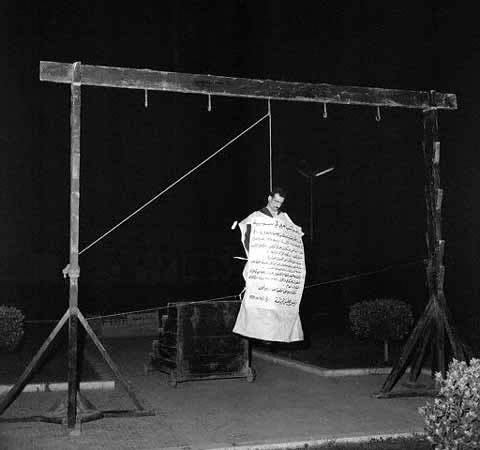
Eli Cohen was executed 46 years ago two years before the Six-Day-War (his Yartzeit is this coming Friday).  Moore than any one single person Eli Cohen was the hero of the June 1967 conflict. He was recruited into Israeli military intelligence in 1960. He was given a false identity as a Syrian Arab who was returning to Syria after living in Argentina. To establish his cover, Cohen moved to Argentina in 1961.


Early the following year, he moved to Damascus. For the next few years, using the alias Kamel Amin Tsa'abet. Cohen gained the confidence of many Syrian military and government officials, and sent intelligence to Israel by radio, secret letters, and occasionally by visiting Israel in person. His most famous achievement was to tour the Syrian fortifications on the Golan Heights. Eli’s influence on Syrian officials helped Israel beyond measure. Cohen suggested that eucalyptus trees should be planted around Syrian military bunkers and mortars on the Golan Heights that were targeting Israel. That way Cohen argued, the trees would provide natural cover for the outposts (eucalyptus trees grow very quickly), preventing soldiers and personnel from suffering the effects of heatstroke. After his suggestion was implemented by the Syrian military, Cohen passed on the information to Israeli intelligence, then the Israeli Air Force (IAF)—using the newly planted trees as a guide—easily destroyed the majority of those bases during the Six-Day War. The mature trees are still evident today when visiting the sites

In January 1965, hired Soviet experts caught him in the act of sending a radio message after large amounts of radio interference brought attention. At the time Eli Cohen was the third in line to the Presidency of Syria After a showcase trial, he was found guilty of espionage. He was publicly hanged by Syria on May 18, 1965. Syria to this day refuses to return Eli Cohen's remains to his family for burial in Israel. A few years ago, in recognition of Cohen's contribution to Israel's survival, the Jerusalem Post interviewed the radio operator who received and decoded Cohen's messages while he was in Syria:

Eli Cohen's radio operator: Spy determined Israel's destiny Yaakov Katz

Forty-three years have passed since he was executed, but Eli Cohen - "Our Man in Damascus" - is still considered by the defense establishment as the greatest spy in Israeli history. On Monday, The Jerusalem Post interviewed the man who for three years received and decoded the transmissions Cohen sent back to Israel from deep inside Syria.

Cohen operated behind enemy lines - establishing close ties with the top Syrian political and military leadership - from 1962 until he was hanged almost exactly 43 years ago on May 18, 1965.

"A," today a 62-year-old veteran of the Israeli intelligence community, was a 20-year-old radio operator with Military Intelligence (MI) when in 1962 he began receiving the daily radio transmissions from Damascus.

"I didn't know who was sending the messages," A told the Post on Monday during a tour of an exhibition on MI's history that will open to the pubic on Independence Day. "It was, however, clear that the short messages were of extreme importance, which later helped determine Israel's destiny ahead of the Six Day War."

Cohen's transmissions were instrumental in helping the IDF prepare for the 1967 war with Syria. He provided information about the Syrian Air Force and military positions on the Golan. Mossad chief Meir Amit has been quoted as saying: "Eli succeeded far beyond the capabilities of most other men."

According to "A," Cohen used to send daily messages always at the same time of the day - 8:30 a.m. Cohen, who was known in MI by the number 566, wrote in encrypted French and sent his messages via a tiny radio transmitter.

As part of Israel's 60th celebrations, MI chief Maj.-Gen. Amos Yadlin decided several months ago to open up the branch's Glilot training base outside of Tel Aviv to Israeli citizens and to put on display there a widespread exhibition spanning 60 years and detailing Israeli Military Intelligence history as well as its many successes.

The exhibition includes a replica of a Hizbullah nature reserve packed with mock Katyusha rockets and anti-tank missiles, guerrilla weapons and surveillance equipment discovered during the Second Lebanon War as well as a model of a 17-meter weapons-smuggling tunnel, dozens of which are believed to be used by Hamas along the Gaza Strip's border with Egypt.

During the tour - which will open Thursday morning - MI will also show a movie that includes never-heard-before radio transmissions from the IDF's hostage rescue operation in Entebbe in 1976.


On display in one of the tents built especially for the exhibition is the last original message that was transmitted to MI headquarters in Israel by the Syrian military following Cohen's capture: "To [prime minister] Levi Eshkol and the handler of his spies: Kamel [Eli Cohen's fake identity in Syria] and his friends have been staying by us for some three years. Signed by: Syrian Arab Intelligence."

"A," who throughout his intelligence career transmitted, received and decoded tens of thousands of messages from Israeli spies, said Monday that he remembered receiving the final transmission.

"There was great excitement and sadness," he said. "We ran to our commander with the message and he passed it on to Eli Cohen's handlers and we understood that it was over."
Cohen was tortured and convicted by a military tribunal which had denied him a lawyer. Despite many appeals, including from Pope Paul VI and the governments of France, Belgium and Canada, to persuade the Syrian government to commute the death sentence, Eli Cohen was executed in Martyrs' Square, Damscus, in May 1965 before some 10,000 spectators.

Despite constant appeals from his family ever since, Eli Cohen's remains were never returned to his family.

May Eli Cohen's memory always be for a blessing, he was a true hero.


Eli Cohen's memorial "Garden of the Missing Soldiers" in Jerusalem


Enhanced by Zemanta
 

KENJI Sponsored by TOPHANT