Showing posts with label Judaism. Show all posts

Wednesday, September 28, 2011

The Jewish Holidays, Personal Responsibility, and Progressivism

With the setting of the sun tonight, Jews across the world will begin the observance of the Yomim Noraim (Days of Awe), a ten day period book-ended by the High Holy Days of Rosh Hashanah and Yom Kippur. This year’s High Holiday period comes at an interesting time for America as the first night of Rosh Hashanah is only 405 days before the United States goes to the polls to choose between two radically different directions, one which emphasizes personal responsibility, the other emphasizes a reliance on government. Only one of those directions is compatible with the true meaning of the High Holidays.

The popular view is the two holidays are observed by going to Synagogue saying a few prayers and begging God for forgiveness. Nothing can be further from the truth.

The High Holiday period is all about personal responsibility. All the prayers and readings are just tools to help us look inward, formulate a personal accounting of our deeds over the past year, good and bad, and to understand what we have learned, or need to learn to correct.

As for forgiveness, we are taught that our maker is not like a big massive government who will fix everything. For earthly-type mistakes, we must first approach the people we have harmed to request forgiveness and if necessary make restitution to them, we must discover what within ourselves led us to mess-up and correct them. Only then can we approach God for absolution.

It’s not that God couldn’t fix everything, but his direct involvement would destroy the delicate balance he set up during creation.

The creation narrative in Genesis explains that man is created in God’s image. The Torah is not teaching us that we are all dead ringers for the “big guy upstairs.” If that was the case everyone’s driver’s license would have the same picture, the Sport’s Illustrated Swimsuit Issue would seem a bit creepy, and no one would be able to solve crimes as eye witness testimony would be useless and everyone would have the same DNA.

“Created in God’s image” is supposed to teach us that just as God acts as a free being, without prior restraint to do right and wrong so does man. God performs good as a matter of his own free choice. Because we are created in his image, man also has the opportunity to do the right thing as a matter of free choice. Only through free choice, can man truly be “in the image of God”. 

That is why God created a world where both good and evil can operate freely. The Rabbis explain this when they said, “All is in the hands of Heaven except the fear of Heaven” (Talmud, Berachot 33b). God controls all the options we have, but it is up to man to pick between good and bad.

Free will is the divine version of limited government. God picks the winning direction, but does not pick winners and losers, nor does he interfere with the process of learning through repentance and understanding ones actions. We are not divinely perfect, nor are we meant to be. We are only supposed to be closer to that divineness when we leave this world, than when we entered it.

Because we all are created in God’s image, Jews believe that ”All men are created equal,” This does not mean, as many in the progressive establishment will tell you, that when it comes to talents, looks, preferences, or natural abilities we are all equal. Nor does it mean we all should have the same big screen TV, wireless internet, or savings account balance. Jewish tradition respects economic success, so long, as it is obtained honestly, and proper respect is shown for the social responsibility that comes with it. That social responsibility is a personal duty and a job for the community led by its religious leaders, but not for the government. The Hebrew word for charity, tzedaka, has in its root the word tzedek which means righteous, because we are taught that personally giving charity is one of the keys to being righteous.

What is actually meant by all men are created equal is we all have the same ability to be infinitely good or wicked, we all have the same ability to forge a relationship with God regardless of our intellectual capability, social background, physical strength, golf handicap wealth, etc. During the high holidays, we evaluate how well we have used the “lot we have been given” for good deeds and to forging that heavenly relationship.

Some of the Sages have suggested that when God created the world, sparks of his holiness were spread across the earth. Every time that a person makes the choice of performing a righteous act, one of those sparks is purified and sent back to heaven. Through that process we become closer to God.

President Obama, the progressive Democrats and the nanny-state government takes away that choice. They believe that if the choice was left up to the individual, they would do the wrong thing. Therefore government needs to take an omnipotent role and control our decisions. By taking away our free will and giving it to the government, liberals retard our spiritual development and remove our opportunity to get closer to God. In a progressive society, the ten “Days of Awe” are not necessary because the government makes our choices.

In a dictionary the word sin is defined as any act regarded as such a transgression, esp. a willful or deliberate violation of some religious or moral principle. There is no word in Hebrew matching that definition. Instead Jews talk about “Chet” missing the mark. It is an archery term referring to an arrow which “missed the target.” The person who missed the mark is considered to have made the mistake due to a lack of focus, concentration or skill. Through personal reflection during the High Holidays Jews can determine why they missed the mark. The answer cannot come from someone else of from the Government. We are told to look for what is in ourselves that made us miss.

In the same vein the word for repentance is “Teshuvah” which means return. In other words we have returned to the correct path to once again hit the target. Repentance implies simply feeling bad for what you have done; Teshuvah involves changing what it is inside you that led you to go off course. And, as the Rabbis tell us, the only way to do that is personal reflection and personal choice (as opposed to governmental regulation). God may give us a road-map in the Torah, Prophets, Psalms and other sacred texts, but to truly change ourselves and ultimately to truly change the world, we have to discover for ourselves the best way to read the road map.

In its purest essence the Jewish High Holiday period is the antithesis of the various forms of Liberal and Progressive government. We learn from those “Ten Days of Awe” that we must be honest with ourselves and rely on our own introspection to find the right path. We learn that while God may be evaluating the path we take and provide a road map to the right way, but he does not make the decisions for us.

Progressive and Liberal governments take that free will away from you, they make the decisions, determine the path, eliminate the need for introspection and your opportunity to find those sparks of God in the world. In the end what those governments take from its citizens is the greatest joy of all, finding for themselves the path that will draw them closer to God.
To all my friends both Jew and Gentile,
Le-shana tova Tikatevu ve-Techatemu
May God Write And Seal You In The Book Of Life For A Good Year.
Enhanced by Zemanta

A Rosh HaShana Story: I Always Walked To Shul with My Father

My face felt flushed, I tried to retain my composure “This is volunteer work. I don’t need the fights, the name calling.” The Rabbi sat across from me quietly. I was telling him why I felt it necessary to resign from the board of trustees. When I ran out of reasons (and breath) there was a moment of silence as he studied me. He leaned backwards into the chair and began to spoke very softly, which in itself had a very calming effect on me. The Rabbi had his own checklist of reasons why I should remain in my position… the last item stopped me dead in my tracks. He said I was an observant Jew who encouraged other people to embrace Judaism.

Observant Jew? Wow! That was the first time in my life anyone had called me that. I never thought of myself as “observant.” Until recently, I was a three-day a year Jew who practically had a booth named after him at the local McDonalds. I stopped there weekly on the way to my 7:25 tee off at the golf course every Saturday morning. My Rabbi’s very generous use of those words made me suddenly realize how much has changed over such a short period of time.

I didn’t grow up very observant. Sure, we would go to services two or three times a year on a Friday night, we always went on the High Holidays, had a big meal on Passover (no Seder though) , and lit an electric Chanukah Menorah every year. My parents worked very worked hard to instill in me strong feelings for being Jewish; they encouraged me to hang out with Jewish kids, allowed me to continue my religious studies after my Bar Mitzvah; and drove me to countless meetings of Jewish organizations. And of course, I was told if I ever brought home a “shiksa,” a non-Jewish girl, my Mom would put her head in the oven (it was an idle threat, our oven was electric not gas).

The most vivid thing I remember about growing up is walking with my Dad all 26 blocks between my house and the Shul, on the High Holidays, both ways. It was such a special time, just my father and me. I would see most everyone else drive their cars, park two blocks away from the locked synagogue parking lot, and walk the rest of the way. It was strange that my Dad felt the need to walk. Maybe he knew that those walks would light an ember inside me, because as I got as I got older and drifted away from Judaism, the remembrances of those walks kept me from moving completely away.

For some reason I always felt comfortable hanging around people who were more religious than me. I worked at the Hebrew Academy Day Camp; many of the girls I dated in high school kept kosher and were Sabbath observant. I admired my observant friends for their willpower and wished that I could join them in their observance, but I couldn’t do it. I believed very strongly in God, but I felt that becoming more observant was too high a mountain to scale,especially all at once. And if you couldn’t do it all, you were a hypocrite to do just some if it.

So I went the other direction and became a kind of a “social” Jew. I wrapped myself in the blanket of Jewish causes and organizations, using them to protect myself from the guilt I felt as I drifted further and further away from the few mitzvot that I did keep. I still took off for the High Holidays and I wouldn’t drive on Rosh Hashanah and Yom Kippur, but I stopped going to Shul.

Once Lois and I got married (she is Jewish, so my mom was been spared that slow suicide via electric oven), I started driving on the High Holidays so we could attend services at my in-law’s shul, an hour's drive away. After they retired to Florida, I would sneak into my sister’s Temple for an hour on the Holidays, I told myself that it was really for my daughter, I wanted her to have some Judaism in her life. But somewhere inside I knew it was for me.

We moved to a bigger house after our second child was born. The house met all my requirements: big backyard, cable TV in each bedroom, close to many public golf  courses, and a reasonable walking distance to the nearest shul….which we promptly joined. I had no intention of doing anything more than sending my kids to religious school, and of course, walking to synagogue three days a year.

In the spring, just eight months after the first High Holiday walk to my new shul, Lois’s mom, of blessed memory, succumbed to a long illness. Though we were not active in the shul or observant, the Rabbi and the congregation immediately embraced us with warmth. During the shiva, the Rabbi visited or called every day and the daily minyon came to our home. This was a new experience for me; when I was growing up, the minyon only came to the big donors homes or the homes of the regular shul attendees. My new shul they didn’t care about my level of observance, or how much I gave; they just cared to provide comfort to the mourners.

After shiva, my wife went to shul every day to say Kaddish. I joined her when I could, which usually didn’t include Shabbat -- my golf day. The more I went, the more those old feelings began to seep out that locked box stored in the back of my mind, that desire to do more.

Around the same time, The United Synagogue (an organization of Conservative shuls in the US) started a home study program. Each day we read one chapter of the Tanach and discussed it via an e-mailing list. Being a commuter I thought it might be fun so I joined. The more I read, the more I wanted to read, and within a few months I was on every Jewish study e-mail list that I could find. I began to attend Shabbat afternoon services just to be able to be able to participate in the Torah discussion that we would have between afternoon and evening services.

Those old feeling of wanting to become more observant became strong again, but this time it was different. My Rabbi encouraged the congregation to become more observant but it was O.K. to do it gradually. Judaism isn’t all or nothing; any step toward Torah is positive. This felt like a new religion -- “No-Guilt Judaism.” The more I studied the more I learned that the approach is not unique.

I began to do little things (for the kids I claimed) like lighting candles Friday night. We went as a family to services every Friday night too. Since golf season was over, I would go Saturday mornings. Even built my first Succah, fooling myself into thinking that it was not for religions reasons -- it was a good project for the children and they love eating outside anyway. Of course the kids were asleep  that first year when I went into the Succah every morning before going to work to say the blessings over the lulav and the etrog.

Almost a year into my journey I took the most difficult step of all. I gave up my prime real estate, my 7:25 Saturday morning tee off. Even though my only Saturday observance was going to shul, I didn’t want to give up the few hours of Shabbat that I did keep, and the more I went, the more I felt that I was connecting with God and with myself. So I gave it up and eventually found a time on Sundays. (my golf game got a lot worse, which just goes to prove the Lord works in mysterious ways).

Over the next two years, slowly, more mitzvoth began to sneak into my routine, never by design. Every once in a while I would wake up wanting to do more: first I decided to stop eating meat from non-kosher animals, and mixing dairy with meat, and began to go to shul for all the Festivals, and bought a new  set of T'fillin to wear at morning minyan each day.

I started to eat only dairy or fish when Lois and I went out to restaurants. Eventually my freezer at home was stocked with kosher meat even though my house was not at all kosher.
I have learned much about the sprit of practicing Judaism . Jewish rituals are not purely the solemn rites as I had always thought they were. They are a chance to have joy, to relish your time with family, community and God. Serve God With Joy became my "mantra"

Have you ever sat in front of a dish of peanuts at a party? You try one peanut, wait a while and soon you have another. The more you have, the faster you want them. Eventually you're jealously guarding your spot on the couch by the dish. That’s what adding mitzvot to your life is like. The key is you don’t have to eat the whole bowl in one sitting.

Rabbi Louis Finkelstein, a great scholar and former Chancellor of the Jewish Theological Seminary of America once defined a good Jew as someone who was trying to become a better Jew. That is the key.  You don’t have to do it all at once, but if you do one mitzvah regularly, something as easy as lighting candles every Friday night, eventually you will want to do another and another.

I once read that when God created the world, sparks of his holiness were spread across the earth. Every time that a Jew performs one of the 613 mitzvot in the Torah one of those sparks are purified and sent back to heaven. I don’t know if sparks have anything to do with but each time I add an observance, I feel a little closer to God, and it is that bit of closeness makes me want more. The guilt that I used to feel for not being observant has been replaced with joy that I am on the right road. My friend Faith, a Conservative Rabbi, put it well. She said that its not that I don’t observe a particular commandment…its that I don’t observe it…yet.

My Dad called me today; he asked me if I changed my mind about quitting the board. I told him that I had. He said, “Good because that’s where you belong.” What he doesn’t realize is that I would have never gotten there if he drove to Shul on Rosh Hashanah, it was clinging to that one mitzvah that put me on the road to observance.

I still walk to shul on the High Holidays. Its not 26 blocks; just two big hills and a valley. Now my dad sleeps at our house because my father still doesn’t like to drive on the holidays. So I get to walk to shul with my Dad again, and my Kids walk with us. Some day when they look back at these walks, I hope that will be as important for them as it has been for my Dad and me.


To all of my readers L'Shanah Tovah Tikatevu. May God grant you and your families health, happiness, laughter and the Love of Family and Friends in the coming year.
(If you cannot see video below Please click here)

Enhanced by Zemanta

Sunday, September 11, 2011

What if Mel Gibson Made A Maccabee Movie and No Jews Came?

To paraphrase Tevye in Fiddler on the Roof, “Lord I know we are your chosen people, but once in a while, can’t you have Mel Gibson choose someone else?”

Gibson’s career reads like a Shakespearean Tragedy. After becoming arguably the biggest star in Hollywood he began displaying his Hubris, spewing hatred against different ethnic groups, much of it against the Jews (or as he has called them “oven dodgers). Gibson’s hatred nearly destroyed his career turning him into at best a b-player. But announced last week, Gibson has been given a big Hollywood project by Warner Brothers. He will be producing and possibly directing (and even starring in) a movie based on Jewish history, the story of Judah Maccabee.

This is not the first time Gibson has tackled Jewish History. In 2004 Gibson was interviewed by Peggy Noonan for Readers Digest in 2004. Noonan asked Gibson if he believed the Holocaust happened. He answered by questioning the number of Jews slaughtered by the Nazi’s and seemed to down play the Holocaust as a Jewish experience.
“I mean when the war was over they said it was 12 million. Then it was six. Now it's four. I mean it's that kind of numbers game. I mean war is horrible. The Second World War killed tens of millions of people. Some of them were Jews in concentration camps. Many people lost their lives. In the Ukraine, several million people starved to death between 1932 and 1933. During the last century 20 million people died in the Soviet Union. Okay? It's horrible.”
These are just a few of many Anti-Jewish acts made by Gibson, the most famous of which occurred during a drunk driving arrest in 2006 when he kept screaming referring to “f***ing Jews” and later stated that “the Jews are responsible for all the wars in the world”

So should Gibson’s Antisemitism prevent him from making a movie about the Maccabees? That's  kind of a hypothetical question because it was Gibson who brought the picture to Warner Brothers. He first said he wanted to make it when he was promoting the Passion of the Christ. At the time he told Sean Hannity that it was a good story, kind of like a western. The real question is once the movie is made, will Jews come out and see it?

Rabbi Marvin Heir, founder and dean of Los Angeles's Simon Wiesenthal Center Museum of Tolerance, voiced his displeasure in statements to The Hollywood Reporter and predicted that Jews should stay home.
"Warner Bros. is making a terrible mistake," Hier says, adding, "most of the people that are going to come to a film about Judah Maccabee are the Jewish community. Surely they know the Jewish communities are not going to come to this film."
I am not as sure as Rabbi Hier is that Jews will stay home. As a people Jews are quick to forgive, Israel considers PA President Abbas a moderate despite the fact that he was one of the people responsible for the Sbarro bombing, American Jews still support Barack Obama despite his anti-Israel policies. In the end the good Rabbi will be very disappointed to learn how many Jews will see the movie.

More than his Anti-Semitic history, I am not sure that Gibson has the background to appreciate the real story of the Maccabees. Gibson is a passionate member of the Catholic Traditionalist movement, a minority Catholic sect that rejects the reforms of the Second Vatican Council in 1964-65 - in particular the abolition of the Latin Mass. Part of the traditional Latin Mass that Gibson so fiercely believes in is about the conversion of the Jews. The prayer reads: "Let us pray also for the Jews, that the Lord our God may take the veil from their hearts and that they also may acknowledge our Lord Jesus Christ." It also refers to their "blindness" and prays for them to be "delivered from their darkness."

This is a direct conflict with the story of the Maccabees who fought against conversion. Only part of the Hanukah story was the Maccabees fight for getting the Greeks out of Israel, and the cleansing and dedication of the Temple. The Maccabees fought a civil war against other Jews. Judah and the boys were fighting Jews who had turned away from their faith by combining it with Greek/Hellenistic practices (or in some cases abandoning the Jewish faith totally). The resulting assimilation caused a loss of Jewish faith and tradition, and finally laws against practicing Jewish ritual.

Sadly in many way’s this story about a war against assimilation of the Jewish people has become the most assimilated of Jewish holidays. Too many treat this holiday as a “Jewish Christmas,” the exact opposite of what the Maccabee story is all about.

That is the reason I don’t believe that Gibson is qualified to produce, direct and possibly star in a movie about Judah Maccabee is not his love or hatred for the Jewish people, but the fact that his view of the Catholic faith, that the blindness of the Jews should be cured so they can accept Christ is the exact opposite of the Maccabee story.

Mel Gibson is entitled to his religious belief, that’s not the issue. The real question is based on his religious beliefs including prayers that Jews should convert could Mel Gibson do the story of the Maccabees justice? Can he tell the true story of the Maccabees in a way that Jews who know the difference will want to see it? Personally I do not see how he can.
Enhanced by Zemanta

Sunday, August 21, 2011

I have Proof That God Still Performs Miracles.

If anybody wants proof that God is still in the miracle business they should read this story about my weekend. My daughter was in a car crash on Friday that by all logic she shouldn't have survived.

At about 5:45pm I was packing up my computer for the night and watching one of my guilty pleasures (TMZ). The phone rang and the stranger on the other end gave me what seemed to be a paradox, your daughter drove into a tree, but is OK. She asked me to call you. It was hard for me to imagine a situation where someone drives into a tree but is basically uninjured. I shouted out to my wife and she joined me in the car as we sped  to the accident site a half of a mile from home.

As we approached we saw two Suffolk County police cars, a fire truck and an EMT ambulance. Having to park a half block away (on the wrong side of the street) my wife ran out of the car to her child crying, I followed. The firemen were shouting to us "don't worry she is OK."

The first thing I noticed as I approached my daughter is the  blood that seemed to be everywhere.  The top of her  head was wrapped as was her neck.  The neck wrapping had already turned red from her blood, but they had quickly covered it up with a heavy duty neck brace. She was surround by EMT workers who were removing a cardiogram and were putting her on one of those hard plastic yellow boards they use when there is fear of a head or neck injury.

My crying wife joined my daughter in the ambulance, while I tried to get her valuables out of the car. Approaching the car, I surveyed the scene. It gave me shivers. My little girl had been very lucky.

Apparently my daughter swerved to the right hit the tree, then pivoted around and the back of her car hit one of those giant 3 feet tall by 4 feet wide, electrical boxes that LIPA puts on every other front lawn. After she hit the electrical box the tree she originally hit smashed down on the driver's side of the car.

As I approached the car the windshield was shattered as was the driver's side window, both airbags deployed, and it was obvious that the worst damage was on the driver's side of the car. Most scary was the roof over her head was flattened from the fall of the tree. All I could think of is how lucky she was.


Driving to the emergency room, I called every observant Jew whose number I remembered. As it was approaching the Sabbath, it would soon be too late to call them and I had a special request for them all. It is a tradition that every time you take out the Torah there is an opportunity to make special prayers of refuah shleimah  (healing)for the ill. Even on the Sabbath when the prayers are mostly prayers of thanks (as opposed to Dear God, I want, I need...) we make prayers asking God to help heal the ill and to grant strength to the doctors who are treating our loved ones.

Mi-sheberakh avoteinu v'imoteinu, Avraham v'Sarah, Yitzhak v'Rivkah, Ya'akov, Rachel v'Leah hu y'varekh et (Hebrew name-Son/Daughter of Mother's Hebrew name) v'yavi aleihem refuat hanefesh u'refuat haguf yachad im kol cholei amo Yisrael. Barukh atah Adonai, rofeh ha'cholim.

May the One who was a source of blessing for our ancestors, bring blessings of healing upon (Hebrew name-Son/Daughter of Mother's Hebrew name), a healing of body and a healing of spirit. May those in whose care they are entrusted, be gifted with wisdom and skill, and those who surround them, be gifted with love and trust, openness and support in their care. And may they be healed along with all those who are in need. Blessed are You, Source of healing. Amen.
Knowing my friends I guarantee you that God heard much about Hinda bat Leah this weekend. From my friends as well as my wife and me.

A short time later, I joined my wife in the emergency room.  It was the first time I was able to see her close up.  My little girl (she is 21 but will always be my little girl) looked like something out of a horror movie.

There was a large cut over her left eye, the white of her skull was visible at the bottom of the  of that injury. The entire left side of her face was a lacerated bloody mess which we had to keep dabbing to keep the blood from seeping into her eye.  She had an extremely deep gash on the left side of her neck which, if it was a bid deeper would have severed her jugular.  In short my daughter was a very lucky girl.

About 10 o' clock that evening the plastic surgeon came in to start his work, telling us that he hadn't seen a face that needed that much work in years. He worked for 3 and a half hours wearing glasses that seemed to have mini microscope lenses coming off the front.  The plastic surgeon delicately stitched together each cut and repaired each laceration.

At about 2 AM we were told that as soon as my daughter could hold down liquids she could go home.  But Saturday morning nothing was too be that easy, after drinking some apple juice, she began to "bring it up again." I am not talking a little throwing up but the projectile stuff only seen in the movie the exorcist.

Finally eight hours later, we were allowed to bring my daughter where she belonged--home. She was battered, tired, in terrible pain, but alive with a good prognosis for the future. She will require some more plastic surgeries and maybe even a skin graft, but the result was much better than it could have been. In the middle of the night, the EMTs had brought a man into the hospital who had a similar accident to my daughter.Unfortunately he didn't make it.

All I could think of is all the help she received, the EMTs, police officers and firemen who rushed to the scene and the doctors, radiologists and nurses who treated her at the hospital.  But just as valuable were the people I called who used their Shabbos rest to pray to God that my little girl survive and have a strong recovery.

A little more than 21 years ago my daughter was born.  I remember when the nurses first placed this screaming little baby into my arms, I marveled at the miracle of the entire process, how God was able to take a piece of me and a piece of my wife and create this little human being that came out of my wife and into our lives.

As I drive my daughter and wife home from the hospital on Saturday I thought back to that time and the injuries she received a little less than 17 hours before.  Just as her birth was a miracle and a gift from God, the fact that she was still alive and coming home was a miracle and gift from our maker.

Her injuries were severe but treatable, but if for example, her neck injury was slightly deeper she might have severed her jugular, bleeding out even before the EMT workers came.

Some might say that the fact my daughter is alive today is the medical and emergency personnel knew what to do and they are 100% correct. But to think they didn't have some help from above defies all reality. The miraculous gift  God gave my wife and me 21 years ago, was re-gifted to us this past Shabbos. 

For those who believe God hasn't performed any miracles in two thousand years (with the possible exception of the 1969 Mets), the fact that my little girl is alive and (God willing) healing, is proof that you are wrong.

As the Jewish Prayer Birkhat Ha‑Gomel says
"Blessed are You, Lord, our God, King of the Universe, Who bestows good things on the unworthy, and has bestowed on me every goodness."
Thank you God, for answering our prayers with a resounding yes.

If anyone wants add their prayers to the ones already praying for my daughter's speedy recovery her name is Hinda bat Leah.


Enhanced by Zemanta

Monday, August 8, 2011

The Connection Between President Obama and The Jewish Fast Of Tisha B'av

The Jewish Fast of Tisha B'Av begins tonight  at sundown. It is one one of only two full day fasts on the Jewish Calendar, the other being Yom Kippur.  Yom Kippur is considered a happy fast, Tisha B'Av is a sad mournful fast. Almost everything bad that happened to the Jewish people happened or Started on Tisha B' Av which is Hebrew for the ninth day of the month of Av.

Tisha B'Av is the culmination of a three week period of increasing mourning, beginning with the fast of the 17th of Tammuz (a half day fast), which commemorates the first breach in the walls of Jerusalem, before the First Temple was destroyed. During this three week period, weddings and other parties are not permitted, and people refrain from cutting their hair (not an issue with me). From the first to the ninth of Av, it is customary to refrain from eating meat or drinking wine (except on the Sabbath) and from wearing new clothing.

Tisha B'Av always reminds me of my Mom. When I was a kid I would cry at the drop of the hat, my mom would tell me that if I continued to cry she would give me something real to cry about. I always thought that it was my mom who invented that expression, but in actuality it was God who invented it, and he invented it on Tisha B'Av

When Moses sent twelve spies into Canaan, ten of them came back with a report that the land was unconquerable. They said the fledgling Israeli nation could never defeat those Canaanite Giants, they claimed. There were cries throughout the Children of Israel asking Moses to take them back to Egypt. They forgot all about God, and his promise to help us conquer the land. That was the first Tisha B'Av. God's response was not only the generation that knew slavery would die out in the desert, but Tisha B'Av will be a horrible day for the Jews until the coming of the Messiah. In other words,like my mom God would give us something real to cry about.

From that day forward, horrible things have happened to the Jewish people on or around Tisha B'Av. Some of them include:

  • The First Temple was destroyed

  • The Second Temple was destroyed

  • Bar Kokhba's revolt against Rome failed

  • In 1290 King Edward I expelled the Jews from England

  • In 1492 the deadline for Jews to leave Spain, Convert or Die

  • The beginning of WWI –which lead directly to the rise of Hitler

  • 1941 Hermann Göring ordered SS general Reinhard Heydrich to make all the necessary preparations for the Final Solution.

  • The first transports reached Treblinka and the extermination of the Jews of the Warsaw Ghetto began on July 23, 1942, Tisha B'av

  • In 1955 El Al Flight 402 was shot down over Bulgarian airspace on the 8th of Av.

  • The AMIA Bombing (Asociación Mutua Israelita Argentina) by terrorists in Buenos Aires, Argentina, which killed 86 and wounded more than 120, was on July 18, 1994, the 10th of Av.

  • In 2004, Barack Obama Gave the Keynote speech at the Democratic Convention on Tisha B'av and was crowned the heir apparent of the Democratic Party. He has proven to be the most anti-Israel President ever.

  • The Disengagement from Gaza began on the 10th of Av 2005, leading to years of rocket bombardment from Hamas into Israel.


    That first Tisha B'Av occurred because we didn't trust God and his promise to give us the land of Israel. In a way our collective egos were too big, even if we felt that we were unworthy of God's reward, as some scholars believe, it was still an ego issue.  After witnessing the ten plagues, the splitting of the Reed Sea and the revelation at Mount Sinai,  we still felt we knew better than God. That he wouldn't keep his promise.

    Thirty-five hundred years later we are still weighted down by our large egos. Many American Jewish leaders seek to gain favor from an anti-Israel President who became famous on Tisha B'av  Jewish organizations have put progressive politics in front of their Jewish objectives. Democrats who were once seen as Israel supporters refuse to stand up to this President and his policies designed to de-legitimize the Jewish State. Other psuedo leaders such as J-Street, are selling-out their people funded by billionaire George Soros, who was born Jewish but rejects its precepts and beliefs.

    Thankfully the polls show the Jewish Vote is drifting away from the president who is bad for the United States and Israel.

    Thirty-five hundred years ago, Israel said they could not conquer the land and were punished. Today many Jews still show no faith in God and God's promise. Even worse, support a United States President, who fittingly has his own ties to Tisha B'av, and who would seemingly have the Jewish State destroyed.

    On this Tisha B'Av, as well as every other day, I will pray that we wake up before it is too late.
    Enhanced by Zemanta

    Thursday, August 4, 2011

    The Fast of Tisha B'av, The Two Kamtzas and the Debt Ceiling Debate


    On the evening of Aug. 8th, Jews across the world begin their observance of the fast of Tisha B’Av, mourning the loss of the two Jerusalem Temples (and many more calamities to the Jewish people). The Talmud tells us the cause of the Second Temple’s destruction was senseless hatred and political insults.

    We are taught that during the first century CE,  a man threw a party and intended to invite his good friend Kamtza. His servant screwed up and mistakenly invited the host’s enemy, Bar Kamtza. This led to the insulting of Bar Kamtza, his slandering of the Jewish people to Caesar, and Bar Kamtza’s purposeful wounding of an animal Caesar sent to the Holy Temple to be sacrificed as a peace offering making it unfit to be used.

    The offering was rejected by the Great Sanhedrin (think of the Sanhedrin as a Rabbinical Supreme Court whose 71  Judges were some of the wisest  scholars who ever lived.) The Sanhedrin met at the Holy Temple in Jerusalem until it was destroyed, after which they moved to Tiberius where today sits the Holy Land's greatest Kosher Chinese restaurant, Pagoda (personally I do not believe that is a coincidence, from this we learned that the wise Rabbis of the Great Sanhedrin enjoyed take out now and then).

    Anyway, Caesar took  the fact that his animals was rejected as a political insult and rebellious move  so he invaded, resulting in the destruction of the Holy Temple.

    The public insulting of one man by one other man steamrolled out of control with the ultimate consequence of the destruction of the Holy Temple, and the exile of the Jewish people from Israel (and the ultimate Kosher Chinese place)  for almost 1900 years. 

    The story of the Kamtzas is apropos for the solemn day of Tisha B’Av,  but is also be a warning for America following two months of a debt ceiling debate riddled with personal insult and hateful rhetoric.

    Despite the insults within and between both political parties, the compromise deal gives a political victory for some and though impotent in a cost cutting way,  it does provide an opening for our leadership to take use this "starting point" as a platform for the additional change necessary so the United States may avoid the Greece scenario and return to fiscal heath.

    Although many in the movement would vehemently deny it, the big winner in the debate is the tea party movement. As recently as June 22nd the progressive Democratic Party were talking about a new stimulus package as part of a debt ceiling bill...but thanks to the tea party movement that scenario is long dead. The tea party movement switched the debate from “spending vs. cutting,” to how “much should be cut and/or from where,” a huge accomplishment.

    Major tea party demands going into the talks were achieved; no new taxes and cuts to the deficit larger than any increase in the debt ceiling. The biggest demand not achieved through the negotiation was the passage of the Balanced Budget Amendment (BBA). The bill passed by the House required that the Senate pass the Amendment, while the final compromise merely requires a vote. The difference is a huge one.  Since almost all of the states have a balanced budget requirement of some sort, and polls report that somewhere between 70-75% of voters want a BBA, once passed by two-thirds of each house of Congress this amendment is likely to "speed" its way thorough the state approval process (75% of the States must approve for it to be added to the constitution). A BBA would most certainly pass the house, house but will be rejected by the progressive-controlled Senate whose members are reluctant to give up their unlimited credit card.

    Speaker Boehner and Minority Leader McConnell were also winners. They held to the "no new taxes" pledge despite rumors they had folded. Boehner gets more credit as he was the face of the opposition, took most of the heat, and showed himself willing to compromise not only with Democrats but with his own coalition to make a deal happen.

    Opinion polls also reflected a voter demand that the the two sides play nice together, however the progressive strategy ignored the public will. They tried to falsely brand the tea party movement as evil, stubborn terrorists whose only desire was to push granny off a cliff and ride their private jets to the yacht club (like Democratic Senator John Kerry?).

    President Obama was the big loser. When the United States needed a leader he was a fear-monger. There was never a chance of the country defaulting on its debts, even without a debt ceiling increase the regular influx of tax dollars proved for the payment of the interest on the debt, medicare, medicaid, payment of all salary and other obligations to military and tens of millions of take out orders from the Tiberius Chinese place.   Rather than explaining the real reasons he felt the increase necessary the President preferred to use frightening rhetoric about defaulting thus rattling an already shaky investment community. Obama also demonized GOP Congressmen who were part of the tea party movement, for being extreme, or being terrorists "holding a gun to our heads" when they   simply trying to keep campaign promises (remember when that was a good thing?) .

    On top of the slanders from the government, their lapdogs in the mainstream media blindly followed their lead. One extreme example is Martin Bashir of MSNBC who interviewed Stanton Peele, a psychologist and an "expert on addiction,"trying to prove  that Tea Partiers ‘Delusional’ Addicts.


    Obama's demand that any agreement go past the 2012 election, extended the crises an additional week and undoubtedly will be exploited by  his eventual opponent who will justifiably claim  Obama chose politics over the needs of the country.

    The President's relationship with Democrats in Congress was severely damaged by this debate. Senior Party members felt Obama’s reluctance to commit on a plan of his own, demonstrated a lack of leadership leaving them to twist in the wind. Party leaders didn’t want speeches, they wanted Obama to roll up his sleeves and come up with his own deal.

    Most members of the liberal wing of the Democratic party were horrified by the details of the compromise. Influential Democratic Rep John Conyers didn't blame the deal on tea party pressure, he said that the House GOP Caucus was simply doing what they were elected to do. Conyers a senior House Democrat placed the blame squarely on  the shoulders of Barack Obama.  He called for a massive rally outside the White House to "educate" President Obama.

    The ever-hapless Senate Majority Leader Harry Reid was a victim. He had negotiated a deal with the GOP a week before the final deal was struck, but the POTUS nixed the deal, leaving Reid to waste the next five days demonizing the Boehner plan (which Reid helped to write). An Obama plan would have prevented this delay and embarrassment.

    Looking to the crystal ball this compromise achieved little real savings. Prior to any the deal it was projected  the national debt will grow from the present $14.5 trillion to $26 trillion in ten years. When  the deal  is factored in, the projection drops to a bit to just over $24 trillion, still an unsustainable burden on the economy.

    As the American economy continues to slide toward insolvency, it is urgent our leaders keep spending under control and it that control has to start with each politicians worst nightmare,  entitlement reform. Last year entitlements such as Social Security and Medicare accounted 56% of the total US Budget, with the onset of real Obamacare spending in 2014 entitlement costs will grow dramatically.

    Sadly most politicians try to avoid that issue.  The liberal side of our government chooses turn any discussion of entitlement reform as an opportunity to demonize the reformer. For example Congressman Paul Ryan's reform plan was quickly followed with a Democratic party ad showing a Paul Ryan look alike pushing his wheel-chair bound grandmother down a hill and off a cliff, a prototypic example of the nasty progressive rhetoric during this round of the budget debate.

    Those who objectively followed the discussion over the past few months, saw the GOP bashing Democratic party proposals with facts and charts, but the Democrat's arguments against Republican plans were void of any facts, but laden with histrionics and name-calling.


    This compromise was a small victory in the battle to keep the United States  from the abyss of over-indebtedness. As pressure-filled this first skirmish was, future ones will be worse, as they will have to deal with the more emotional issues surrounding entitlement reform.

    In order for our country to survive,  our leaders will have to cut our spending without cutting each others throats by falling into the typical Democratic party strategy of  insults, ego and vitriolic rhetoric. As we learned in the story of the Kamtzas hateful words are sufficient go begin a process here the holiest place on earth is destroyed, imagine what it could do to  country, although great does not posses the holiness of the Second Temple.

    Wednesday, June 1, 2011

    The Ancient Greeks, Romans And Even Early Muslims Recognized Jerusalem as Jewish

    http://unitedwithisrael.org/wp-content/uploads/2011/05/ancient-jerusalem.jpg


    Today,  Jews across the world observe Yom Yerushalayim, Jerusalem Day. It celebrates that day 44 years ago when Israeli troops reunited Jerusalem and Jews were able to pray at holy sites in the old city for the first time in almost 20 years.

    One of the Palestinian Authority's famous frauds is the claim that there was never a Jewish Community in the Holy Land. They like to say that any Jewish claim to Jerusalem or the Temple Mount began with the Zionist movement 100 years ago. Of course that's a lie.

    Even after the Bar Kochba revolt in 135 CE when the Romans punished the Jews  for revolting by changing the name of their country from Judea to Palestinia (after the Philistines the ancient Jewish Enemy who no longer existed) and the name of the holy city from Jerusalem to Aelia Capitolina (literally Capitoline Hill of the House of Aelius) ,  most of the world recognized the Holy Land and Jerusalem as Jewish. The truth of the matter is that even ancient Muslim writings recognized Jerusalem as a Jewish City.

    For ancient Greek and Roman pagan authors, Jerusalem definitely was a Jewish city. An examination of their texts indicates the unanimous agreement that Jerusalem was Jewish by virtue of the fact that its inhabitants were Jews, it was founded by Jews and the Temple, located in Jerusalem, was the center of the Jewish religion.

    These ancient texts, disprove recent attempts by Muslims and others to deny the historic connection of the Jewish people to Jerusalem and the location of the Temple in Jerusalem through fabrications and lies.


    The Greeks probably were the first to record information about the customs, life styles and societies of the different peoples whom they encountered or heard about during their travels in various parts of the world. Jews were one of the many peoples whom they met and observed.[10] 


    In the late fourth century BCE, several texts portray Jews in a complimentary fashion, as philosophers.[14] Throughout the third century BCE, however, less favorable comments about the Jews circulated throughout Ptolemaic Egypt, which had undergone rapid Hellenization. Outstanding among the anti-Jewish accusations was an alternative to the Biblical narrative of the Exodus.[15] One of the anti-Exodus tales, presented by the Egyptian priest Manetho (mid-third century BCE) portrayed the Jews as foreigners, descendants of shepherd-kings who had taken over Egypt and had joined with others who were ridden with disease and killed the animals which the Egyptians venerated as gods.[16] Subsequently, they were expelled from Egypt and established their own polity under their leader Moses who gave them a way of life which differed from that of the rest of mankind. Hence, the Jews were accused of xenophobia and disrespect for the gods of other nations and were viewed as practitioners of a strange way of life.[17]

    Some writers recall distinctive Jewish customs, such as the absence of representations of the deity, male circumcision, dietary laws and the observance of the weekly day of rest, the Sabbath. Indeed, in 167 BCE, the Greek Seleucid King Antiochus IV ordered Jews to place an idol of Zeus in the Temple, outlawed circumcision, demanded the sacrifice of swine and forbade Sabbath observance (I Maccabees 1:41-50). He thus desired to eliminate those unique features of the Jewish religion which had been noted by pagan writers.

    Anti-Exodus narratives and accusations of Jewish sacrilege against other nations' gods emerged in times of political and cultural crises and may have been a reaction to the fact that Judaism was attractive to many Greeks and Romans.[18] By the middle to late first century BCE, the Romans dominated much of the known world west of the Euphrates, with its large Greek and Jewish populations. The Romans adopted many of the Greek charges against the Jews, to which they added accusations of insubordination to Roman rule.

    So embedded were the Greek libels, that even several decades after the brutal suppression of the Jewish revolt against Rome (66-70 CE) and the destruction of the Temple and of Jerusalem (70 CE), the Roman historian Tacitus repeated the standard anti-Exodus canard and expressed himself as though the Jews were still a major threat to Imperial world domination, as follows: "... Moses introduced new religious practices, quite opposed to those of all other religions. The Jews regard as profane all that we hold sacred; on the other hand, they permit all that we abhor."[19]

    During the decades and centuries following the conquest of the Near East by Alexander the Great in the 330s and 320s BCE, Greek soldiers and civilians populated and colonized the entire area, established major cities, such as Alexandria in Egypt, and spread their system of local government, language, culture, art, religion, and way of life throughout the region. The Greeks promoted and advocated the adoption of their life style and mores; namely, Hellenization, which in contemporary parlance may be termed the first manifestation of "globalization." All the peoples whom they ruled and amongst whom they lived, including the Jews in the Land of Israel and the Diaspora (a Greek term), had to contend with the challenge of Hellenization through assimilation, adaptation or resistance.[13]


    Even 2,000 years ago Antisemitism was popular in western cuture.


    According to Manetho, for example, after Pharaoh expelled the sacrilegious Jews, a tribe of the usurper shepherd-kings called "Hyksos" dominated the land. They were joined by others who were afflicted with leprosy and diseases. "They journeyed over the desert ... they built in the land now called Judaea a city large enough to hold all those thousands of people and gave it the name of Jerusalem." In a subsequent section, Josephus again quotes Manetho as stating that after the Jews "were driven out of the country, [they] occupied what is now Judea, founded Jerusalem, and built the temple." While Josephus wrongly cites Manetho's history as attributing to Moses the building of the Temple, he mentions that Manetho notes that Moses "who framed their [the Jews'] constitution and their laws" was a native Egyptian.[20]
    In an account by Hecataeus of Abdera (c. 300 BCE), Jerusalem appears toward the conclusion of his counter-Exodus account and before his description of Jewish society and practices. He attributes the expulsion of the Jews to the pestilence which the Egyptians blamed upon the presence of foreigners, not only Jews, who caused the natives to falter in religious observance. "Therefore, the aliens were driven from the country." While some went to Greece, most "were driven into what is now called Judaea ... at that time utterly uninhabited ... on taking possession of the land, he [Moses] founded, besides other cities, one that is the most renowned of all, called Jerusalem. In addition, he established the temple that they hold in chief veneration, instituted their forms of worship and ritual, drew up their laws and ordered their political institutions."[21]
    Hecataeus and other writers designate Moses as founder of Jerusalem, builder of the Temple, and architect of the Jewish religion. .. For a Greek, however, it would make sense that Moses built the Temple. Logically speaking, the first major leader of people, conqueror of its land and creator of its laws and social norms had to be regarded as the founder of its most important city and shrine. It is noteworthy that Moses "the Lawgiver" figures prominently as the founder of Judaism both in Greek and Roman writings and in Josephus' defense of Judaism in the second half of his Against Apion.[22]

    While the narratives noted above feature Moses as the founder of the Temple, three relatively obscure sources of the second century BCE link the Temple to King Solomon and point out his association with King Hiram of Tyre, who assisted in its construction. These sources are brief and contain no historical background or material on the Jews.[28]

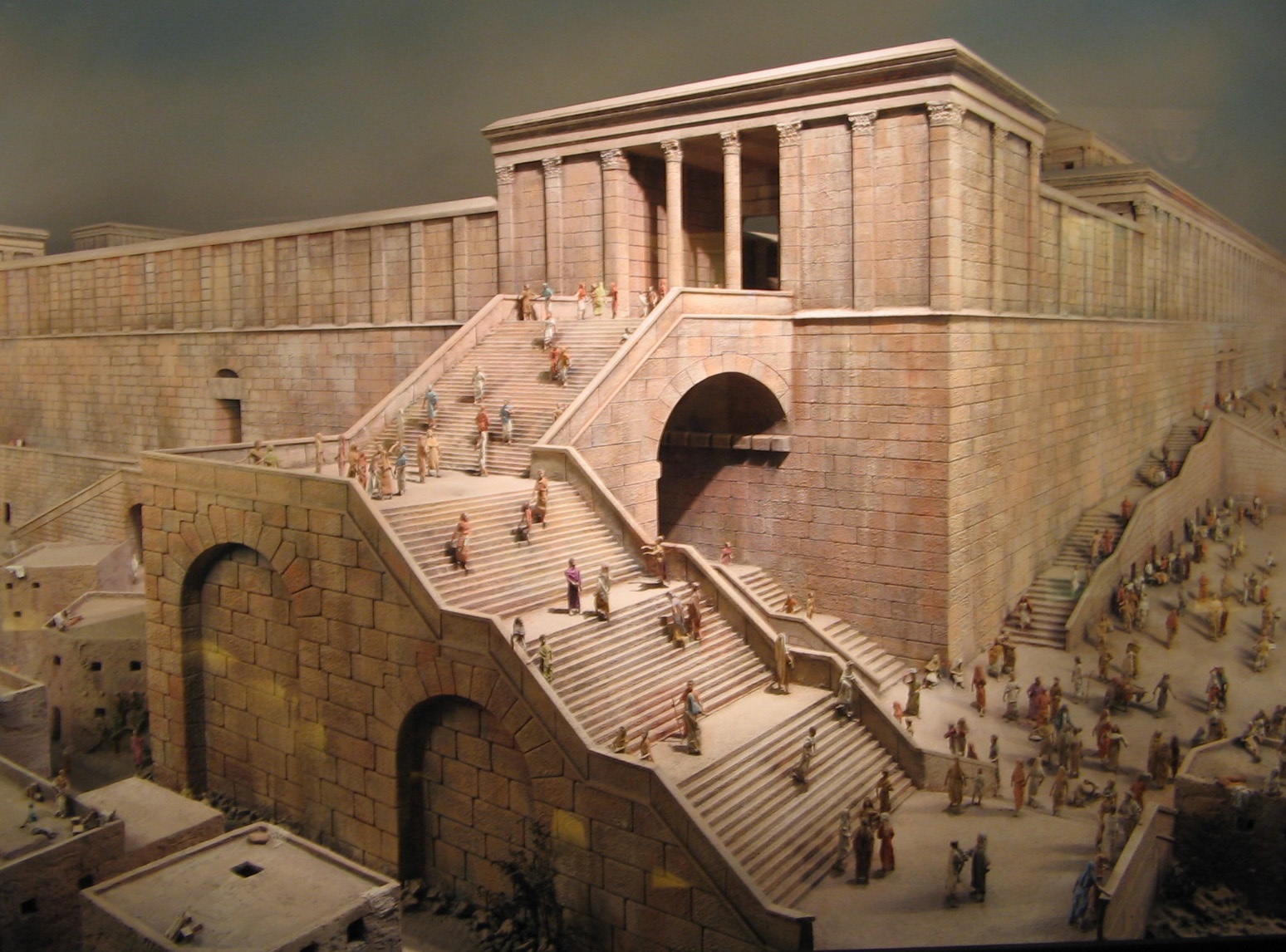
    Several of the selections in Against Apion which include the anti-Exodus narrative also provide descriptions of the interior and exterior of the Temple and some of its rituals. For example, Hecataeus states that in the center of the city is an enclosure where there is "a square altar built of heaped up stones, unhewn and unwrought." The Temple itself is "a great edifice containing and altar and a lamp stand, both made of gold ... upon these is a light which is never extinguished ... there is not a single statue or votive offering, no trace of a plant in the form of a sacred grove, or the like."[29] And in his account of Titus' siege of Jerusalem, Tacitus describes the Temple as "... built like a citadel, with walls of its own ... the very colonnades made a splendid defense. Within the enclosure is an ever-flowing spring."[30]

    In addition to physical descriptions, the authors mention the religious aspect of the Temple which differed radically from Greek and Roman paganism. In the text preserved by Diodorus, Hecataeus mentions the priests and their duties in the Temple and even describes a worship service and sacrifice.[31] Similarly, the first century Roman historian Livy remarks that the Jews do not state "to which deity pertains the temple at Jerusalem, nor is any image found there, since they do not think the God partakes of any figure."
    In the same vein, Tacitus reports that "there were no representations of the gods within, but ... the place was empty and the secret shrine contained nothing" and "only a Jew may approach its doors, and that all save the priests were forbidden to cross its threshold."[32] Cassius Dio (c.200 CE) recalls that the Jews "never had any statue of him [the deity] even in Jerusalem itself." The latter states that their temple "was extremely large and beautiful, except in so far as it was open and roofless."[33]

    Hecataeus, Livy, and Cassius Dio explain the absence of representation as part of Jewish "otherness" in a factual manner. Several Greek writers, however, interpret the fact that there were no statues of the gods in the Temple not only as unusual, but also as barbaric and indicative of Jewish misanthropy. In their view, it would be inconceivable that a sacred shrine would be empty. Therefore, several authors offered their versions of what exactly stood in the Temple. Diodorus (first century BCE) writes that when "Antiochus, called Epiphanes, on defeating the Jews had entered the innermost sanctuary of the god's temple, where it was lawful for the priest alone to enter. Finding there a marble statue of a heavily bearded man seated on an ass, with a book in his hands, he supposed it to be an image of Moses, founder of Jerusalem ... who had ordained for the Jews their misanthropic and lawless customs. ... Antiochus ... sacrificed before the image of the founder and the open-air altar of the god a great sow."[34] Diodorus asserts that what stood in Judaism's holiest place was ridiculous and revolting; namely, the presence of a statue of an ass, a lowly beast of burden, whose rider had established Jewish xenophobia, and that Antiochus sacrificed an animal known by all to be forbidden to the Jews in their holiest shrine.[35]
    With the Antisemitism, the Greeks also started the "blood libel"

    Apion (mid-first century CE) conveys a malicious and defamatory description of the contents of the sanctuary in Jerusalem. In order to give his anti-Jewish arguments greater authority, Apion attributes this account to the well known Greek philosopher and ethnographer Posidonius (c.135-51 BCE) and the rhetorician Apollonius Molon (first century BCE).[36] As in the case of Diodorus, the invasion of Antiochus Epiphanes serves as the point of departure for the description, as follows: "Within the sanctuary ... the Jews kept an ass's head [made of gold], worshipping that animal and deeming it of deepest reverence."[37]

    The narrative continues with an astonishing calumny. Apion relates that when Antiochus entered the sanctuary, he discovered a Greek imprisoned inside, on a couch next to a table laden with excellent food. The Greek hailed Antiochus as his savior. For, according to Apion, the Jews kidnapped a Greek annually, brought him to the sanctuary, fattened him up with sumptuous meals, sacrificed him, ate his flesh and then swore an oath of hostility to the Greeks.[38] While Josephus dismisses this canard as malicious rubbish and baseless lies, it is clear that the fact that Jews had no statues in their Temple in Jerusalem served as the background for the fabrication of accusations of kidnapping, human sacrifice, cannibalism and misanthropy on the part of the Jews.[39] This libel provided a basis for the attempts to deprive them of their civic rights which were contested in Alexandria in the first century CE by figures such as Apion. Hence, the Temple appears as a salient feature of pagan anti-Judaism.
    Panorama of Jerusalem Taken in Early 1800s
    In addition, the fact that Jews contributed annually to the Temple thereby filling it with silver and gold objects and monies was considered as a point of contention. In 59 BCE, the great Roman orator Cicero defended Flaccus, when the latter sought to prevent the Jews of the Empire from sending large sums of money to Jerusalem. Cicero describes the collection of vast amounts of gold and calls Judaism a "barbaric superstition."[40]

    Tacitus also adds a financial dimension to his critique of Judaism and the Temple, complaining that other peoples join the Jews, "renouncing their ancestral religions ... sending tribute and contributing to Jerusalem, thereby increasing the wealth of the Jews."[41] While both Cicero and Tacitus mention Jerusalem as the destination for the contributions of the Jews, it is clear from the context that their intention is the Temple, which the latter describes as "possessing enormous riches."[42]

    In conclusion, descriptions of the Temple form part of the accounts on Jerusalem and on Judaism. They range from the factual to the libelous and bizarre. For the Greeks and Romans, Jerusalem was famous for its Temple which served as the focal point of the xenophobic, strange and possibly menacing rites of the Jews whose contributions brought much gold into the city. The latter may have encouraged a certain amount of envy among Gentiles. After its destruction in 70 CE, the memory of the Temple persisted in the retrospective histories by Tacitus and by Cassius Dio.
    Jerusalem and the Temple also appear as the site of several major historical events, mainly invasions of Greek monarchs and Roman generals. We have seen the significance of Antiochus IV Ephiphanes' entry into Jerusalem and his despoliation of the Temple which served as the pretext for anti-Jewish descriptions of the interior of the sanctuary, distortions of Judaism and slander of the Jews. Antiochus appears favorably in the works of Diodorus and Apion, cited above. Similarly, Tacitus presents Antiochus positively as the prototype of a leader who attempted to "abolish Jewish superstition and to introduce Greek civilization."[43]

    It is noteworthy that an earlier capture of Jerusalem by the Greek-Egyptian King Ptolemy, son of Lagus, provided an opportunity for the obscure Agatharchides of Cnidus (second century BCE) to remark about the fact that "the people known as Jews, who inhabited the most strongly fortified of cities, called by the natives Jerusalem" lost their city because they would not defend it on the Sabbath. Josephus includes this selection in Against Apion as one of the early pagan critiques of the Jewish Sabbath which Agatharchides deemed as "folly," "dreams," and "traditional fancies about the law."[44]

    In this instance, the capture of Jerusalem serves as background for the author's unfavorable comments on the Sabbath. Similarly, Cassius Dio attributes the capture of the Temple by the Roman general Pompey the Great in 63 BCE to the fact that the Jews, given their "superstitious awe" did not defend the city on "the day of Saturn" (the Sabbath).[45] Cassius Dio, however, concentrates on Roman victories and accomplishments and mentions the issue of the Sabbath in passing.

    The biographer Plutarch (mid-first-early second century CE) notes the siege of Jerusalem by the Seleucid monarch Antiochus VII Sidetes in 133-132 BCE at the time of the Jewish Feast of Tabernacles. The author describes this festival at length in another work.[46] According to Plutarch, Antiochus VII provided the sacrificial animals for the Temple and allowed a seven day truce, after which the Jews submitted to him.[47] From this passage, it is clear that the inhabitants of Jerusalem are the Jews; that their Temple is located there; and their religious practices affect the outcome of the invasions of Greek rulers.

    Jerusalem also serves as the venue for eliciting praise of Roman figures or glorifying the victories and history of Rome. The invasion of Jerusalem and the Temple by Pompey the Great in 63 BCE appears in several Roman sources. Livy erroneously states that Pompey was the first to capture Jerusalem and the Temple.[48] Other authors focus on the fact that Pompey neither damaged the Temple nor removed any of the gold or he vessels of the Temple.[49]

    While Jerusalem and the Temple are important in these sections, they serve as the background for praise of the Roman invader. Similarly, in the works of Tacitus and Cassius Dio, the city of Jerusalem and its destruction form part of the history of the Roman Empire, and in the case of Tacitus, the accomplishments of the Flavian dynasty.[50] These historians assume Roman cultural superiority and political hegemony throughout the world and the conquest and subjugation of Jerusalem supported this world-view.

    An outstanding example of the role of Jerusalem as the location for a minor event in the life of an emperor may be found in Suetonius' The Twelve Caesars, a work replete with intimate details of the public and private lives of the first twelve Roman emperors. In his biography of Titus, then commander of his father Vespasian's Imperial forces and later emperor, Suetonius writes that "in the final attack on Jerusalem he slew twelve of the defenders with as many arrows; and he took the city on his daughter's birthday, so delighting the soldiers and winning their devotion ..."[51] In this case, "the personal is political" and Jerusalem serves as the location for commemorating an event in the private life of Titus.

    Finally, Cassius Dio's indispensable account of the Jewish revolt against the Emperor Hadrian (132-135 CE) designates the following as a cause of the revolt: "At Jerusalem he [Hadrian] founded a city in place of the one which had been razed to the ground, naming it Aelia Capitolina, and on the site of the temple of the god, he raised a new Temple to Zeus [Jupiter]."[52] Dio then proceeds with his report of the revolt of the Jews and its methodical suppression by the Romans.

    Although the source concentrates on the course of the revolt against Hadrian, the founding of a pagan city on the ruins of Jerusalem and a pagan temple on the Temple Mount is presented as a historical fact and not simply as background for the author's views on the Jewish religion or his praise of a particular emperor. Once again, Jerusalem, the Temple and the Jews are linked together in the major Roman historical work, written over more than a century after the destruction of the city and its holiest place.
    All of this happened between 500-1,000 years before Islam was founded by the Muslim prophet Mohammad.  There is even a Koranic passage which indicates that Jerusalem might not be so holy to Muslims, and is passed on to the Jews  "

    (Koran, Sura 2:145, "The Cow")


    "...They would not follow thy direction of prayer (qiblah), nor art thou to follow their direction of prayer; nor indeed will they follow each other's direction of prayer..."  

    Commentators explain that "thy qiblah" (direction of prayer for Muslims) clearly refers the Ka'bah of Mecca, while "their qiblah" (direction of prayer for Jews) refers to the Temple Mount in Jerusalem.

    This Koranic passage appears to show that the holiness of Jerusalem a Jewish concept, and should not be confused with an Islamic concept.

    The 13th-century Arab biographer and geographer Yakut noted: "Mecca is holy to Muslims, and Jerusalem to the Jews."
    On this 44th anniversary of the reunification of Jerusalem it is important to note that the Muslim claims on the holy city is a false one. All text prior to the establishment of Islam point to Jerusalem as the holy city of the Jews and home to the temples of God. And even the early texts of Islam differentiate between Jerusalem as the city holy to the Jews and Mecca the city holy to Muslims.


    Today the Muslim world claims Jerusalem as theirs only as a straw dog, to further delegitimize the Jewish hold on the Holy Land. They understand even more than some Jews that Israel is the heart of the Jews, Jerusalem is the heart of Israel, and the Temple Mount is the heart of Jerusalem.  Rip out the heart and the body will die.


    The Greek and Roman history is excerpted from a white paper called,"Jerusalem: Capital of the Jews The Jewish Identity of Jerusalem in Greek and Roman Sources by Rivkah Fishman-Duker. If you have the time I recommend you read the entire piece.


    Footnotes follow.

    [11] Herodotus, Historiae II, 104:3; Stern, I, No. 1,,2.

    [12] On the twentieth-century Palestinian Arab adoption and use of the terms "Palestine" and "Palestinian" as labels of ethnic identification, which originally and for millennia were geographical terms see Bernard Lewis, "The Palestinians and the PLO: A Historical Approach," Commentary, 59 (January, 1975), 32-48. Lewis notes that the Roman renamed Judea "Syria-Palestina" and Jerusalem as "Aelia Capitolina" in 137 CE, in order to "stamp out the embers not only of the [Bar Kokhba] revolt but of Jewish nationhood and statehood ... with the same intention - of obliterating its historic Jewish identity," 32.

    [13] For a summary of scholarly interpretations of the varied reactions of Jews to the impact of Hellenism and the significance of Hellenization in Jewish history of the Second Temple and Talmudic periods see L. Levine, "Hellenism and the Jewish World of Antiquity," Judaism and Hellenism in Antiquity: Conflict or Confluence (Seattle: University of Washington Press, 1998), 3-32.

    [14] Momigliano, 90-91; Johanan Hans Lewy, "Aristotle and the Jewish Sage," in: Studies in Jewish Hellenism (Hebrew: Olamot Nifgashim) (Jerusalem: Bialik Institute, 1969), 15-43; Josephus, Against Apion, I, 176-183; Stern, I, VII, no. 15, 47-52.

    [15] On the anti-Exodus narrative as a major motif of Greco-Roman anti-Semitism: Van der Horst; Schaefer, 15-33. Momigliano, 91-95, holds that the Greek authors either did not know of the account of the Exodus in the Septuagint, the Greek translation of the Torah or refused to acknowledge its historicity. In contrast, Erich S. Gruen maintains that these tales were not part of a concerted pagan anti-Jewish campaign and they "do not derive from Egyptian distortion of Jewish legend, but the reverse, Jewish inventiveness expropriated Egyptian myth." ("The Use and Abuse of the Exodus Story," Heritage and Hellenism: The Reinvention of Jewish Tradition (Berkeley: University of California Press, 1998), 41-73, especially 71-73. Gruen's argument, however, is neither relevant nor convincing as it is clear that the oft-repeated anti-Exodus tales indeed formed part of the essential underpinning for anti-Judaism and Jew-hatred in the Greco-Roman world. For a reaction to Gruen, see John J. Collins, "Reinventing Exodus: Exegesis and Legend in Hellenistic Egypt," Jewish Cult and Hellenistic Culture (Leiden: Brill, 2005), 44-57 and 191-193.

    [16] The anti-Exodus texts by Hecataeus: Aegyptiaca, in: Diodorus Siculus, Bibliotheca HistoricaAgainst Apion I, 183-204; Stern, I, V, no.12, pp.35-44; and by Manetho, in: Against Apion I, 73-91, 93-105, 228-252; Stern, I, X, nos.19-21, 66-86. On theories concerning the date of the texts attributed to Hecataeus, see Note 21. XL:3 (Photius, Cod. 244) Stern, I, V, no. 11, 1-8; pp. 20-35; in:

    [17] Van der Horst, op.cit.

    [18] Daniel R. Schwartz, "Introduction," Studies in the Jewish Background of Christianity., 3-14, argues the crises which stimulated anti-Jewish writing were the influx of Jews into Ptolemaic Egypt during the third century BCE, the triumph of the Hasmonean dynasty (mid-late second century BCE) against the Greek Seleucids, Hasmonean policies toward Greeks, the subjugation of formerly Greek dominions to the Romans, and the crisis fomented by Roman Emperor Gaius Caligula's insistence on worshipping his statue. Later Roman intellectuals perceived attraction to Judaism and Jewish missionary activity as undermining their traditional way of life. Repeating the anti-Exodus material in order to support his campaign against the rights of Jews, Apion led the Greek delegation to the Emperor Gaius Caligula (37-41CE) during the period of inter-ethnic crisis in Alexandria, aggravated by the Imperial policies and the pogrom of 38 CE. On Alexandria, see: Van der Horst op.cit; Schaefer, Judeophobia, 136-160; and Collins, "Anti-Semitism in Antiquity? The Case of Alexandria," op.cit., 181-201. (Tuebingen: Mohr, 1992), 10-15, attributes the wide-spread phenomenon of conversion to Judaism, a way of life and set of beliefs which transcended territorial boundaries, to the influence of the massive acculturation to Hellenism throughout the Mediterranean world, whereby one could become Hellenized without living in Greece. On the attraction of Judaism and the success of proselytism among Greeks and Romans see Feldman, 177-341. J.H. Lewy, "The Second Temple Period in Light of Greek and Roman Literature", op.cit

    [19] Tacitus, Historiae V: 4:1, Stern, II, XCII, no. 281,19, 25. According to Bloch, 221-223, Tacitus' excursus on the Jews reflects the anti-Jewish discourse of the Flavian era and beliefs in the superiority of the Roman Empire. See Goodman, 453 ff. Erich S. Gruen, however, downplays any notion of a "long-simmering hostility" as the basis of anti-Jewish expression in the wake of the revolt in Judea and attributes negative Roman attitudes to the shock of the challenge of a "laughable" people. Gruen, "Roman Perspectives on the Jews in the Age of the Great Revolt," in Andrea M. Berlin & J. Andrew Overman, The First Jewish Revolt: Archaeology, History, Ideology (London: Routledge, 2002), 27-39.

    [20] Manetho's references to Jerusalem come from his Aegyptiaca, refuted by Josephus in Against Apion I, 90; I, 93; I, 228; Stern, I, X, no.19, 68-69; no. 20, 74-75; no. 21, 78,81,83.

    [21] Hecataeus, in Stern, I, V, no. 11, 26-28. According to Stern (I, 20-24), Hecataeus wrote in c. 300 BCE. His Aegyptiaca comes down to us from the first century B.C.E. work of Diodorus Siculus via the tenth-century Bibliotheca of Photius. Diodorus may have altered the original text. In Against Apion I, 183-204, Josephus includes a selection entitled "On the Jews" by Hecataeus, which was regarded as the earliest Greek description of the Temple and Jerusalem. Several scholars have challenged the authenticity of the passages in Josephus. Stern presents the commonly accepted opinion that "Josephus had before him a Jewish revision, however slight" which was more pro-Jewish than the original Hecataeus (I, 23-24). However, an exhaustive study of the material which Josephus attributes to Hecataeus, asserts that it was written by an Egyptian Jew of the late second- early first century BCE and not by Hecataeus at all, see Bezalel Bar Kochba, Pseudo-Hecataeus' On the Jews: Legitimizing the Jewish Diaspora (Berkeley: University of California Press, 1996), especially 110-121, 249-252. This view suits Erich S. Gruen's later thesis (Note 15), although it is not universally accepted. See also Bloch, 29-36.

    [22] On Moses in pagan writing: Feldman, Jew and Gentile, 232-287. On the Greek logic behind the identity of the founder of the religion, conqueror of the land and builder of the shrine see Bloch, 34, Note 38. Josephus, Against Apion II: 154-178, 352-365. Josephus argues that Moses is the oldest legislator in human history and that his laws are superior to those of other peoples and they are accessible to all.

    [23] Diodorus, Bibliotheca Historica XXXIV, 1: 1,2, 3, in : Stern, I, XXXII, no. 63.

    [24] Lysimachus, in: Against Apion I, 304-311; Stern, I, LXII, no.158, 383-386. Stern notes that Lysimachus' reference to "Hierosyla" is an example of the etymology of a name of a nation (386, no.311).

    [25] Tacitus, Historiae V, 2:1-2; Stern, II, XCII, no. 281, 17-18, 24-25. Stern points out that Tacitus' references to "Hierosolymus "and "Iuda" resemble those of his contemporary Plutarch (33, Note 2:2). For Plutarch: Stern, I, XCI, No. 259, 563..

    [26] Tacitus, Historiae V, 3: 1-5:5; Stern, II, XCII, no. 281, 18-19, 25-27.

    [27] Tacitus, Historiae V, 6:1-13:4; Stern, II, XCII, no. 281, 19-23, 27-31. Bloch, 102-107, points out correctly that Tacitus devotes hardly any attention to the political history of Judea prior to the Great Revolt, siege of Jerusalem by Titus. It simply did not interest him. The otherness of the Jewish religion, which he knew from the Jews of Rome, however, merited his critique (Bloch, 222-223).

    [28] Menander of Ephesus, in Against Apion I, 126; Stern, I, XX, no.35, 120-121; Dius, in Against Apion I, 114-115; Stern, I, XXI, No. 36, 124-125; Laetus, in Stern, I, XXIII, No.39, 128-129. Perhaps these authors were acquainted with the Biblical account which describes the relationship between Solomon and Hiram and the latter's role in providing materials for the Temple or obtained their information from an unknown Phoenician source.

    [29] Hecataeus "On the Jews", in Against Apion I, 198-199; Stern, I, V, No.12, 36-37, 39. See Note 21 on the problems relating to this passage. Bar Kochba, 153-154, 160-168, states that the author, Pseudo-Hecataeus, an Egyptian Jew at the turn of the first century BCE, based his description on Greek literary models of temples and was acquainted with pagan temples and their surroundings. Therefore, the Temple in Jerusalem is not the structure described in the text.

    [30] Tacitus, Historiae V:12:1 (Stern, II, XCII, no. 281) 22,30.

    [31] Hecataeus, in Diodorus, Aegyptiaca, Bibliotheca Historica XL, 3, 4-6; Stern, I, V, No. 11, 26-28.

    [32] Livy, in Stern, I, XLVI, No. 133, 330. Tacitus, Historiae V: 8:1, 9:1; Stern, II, XCII, No. 281, 21, 28. Tacitus relates that only after Pompey's invasion of the Temple in 63BCE did the emptiness of the sanctuary become common knowledge. He does not repeat the Greek calumnies and rumors about the sanctuary.

    [33] Cassius Dio, Historia Romana XXXVII, 17:2-3; Stern, II, CXXII, No.406, 349, 351.

    [34] Diodorus, Bibliotheca Historica, XXXIV:2-4; Stern, I, XXXII, No.63, 182-183. On the pagan accusation of Jewish ass worship see Schaefer, 58-62.

    [35] This account differs from the Jewish versions of Antiochus IV invasion of Jerusalem and desecration of the Temple of I and II Maccabees. While all stress Antiochus' attempts to abolish Jewish practices, Diodorus states that after taking tribute from the Jews and dismantling the walls of Jerusalem, he left the Jews alone. He does not mention the Jews led by Judah the Maccabee taking the Temple from Antiochus' soldiers and supporters and consecrating it.

    [36] Posidonius, in: Against Apion II, 80, 89-96; Stern, I, XXVIII, No. 44, 145-146; Apollonius Molon, in: Against Apion II, 80, 89-96; Stern, I, XXIX, No. 48, 12-154; Apion, in: Against Apion II, 80-90-96; Stern, I, LXIII, no.170, 408-412.

    [37] Ibid.

    [38] Ibid.

    [39] An explanation of the origins of Apion's accusation of cannibalism on the part of the Jews may be found in Stern, I, 412, Note 89. See also Schaefer, 62-67. Periodic kidnapping and killing of a Gentile, of course, occurs in the medieval blood libels, the first of which took place in Norwich, England in 1144. There are vast differences between Apion's claims and the context of blood libels in Europe, in which innocent Christian children appear as the victims, murdered by Jews who use their blood for Passover rituals.

    [40] Cicero, Pro Flacco 28:66-69; Stern, I, XXXIV, No.68, 196-201. On Cicero's attitude to the Jews see J. Lewy, "Cicero and the Jews in the Pro Flacco," op.cit ., 79-114. According to Feldman, 70, the Jews were so loyal to Jerusalem and the Temple that they were prepared to defy a Roman edict and send large sums of money to the Temple.

    [41] Tacitus, Historiae V, 5:1; Stern, II, XCII, No. 281, 19, 26. Both Bloch, 93 and Feldman, 110, state that the fact that the numerous proselytes also paid the annual half-shekel to the Temple in Jerusalem resulted in the accumulation of vast sums of money collected throughout the Empire and sent to the Temple treasury, thus causing Gentile envy of Jewish wealth and antipathy toward converts to Judaism.

    [42] Tacitus, Historiae V, 8:1; Stern, II, XCII, no. 281, 21, 28.

    [43] Tacitus, Historiae V, 8:2; Stern, ibid.

    [44]Against Apion I, 209-211; Stern, I, XVII, No. 30a, 106-107.

    [45] Cassius Dio, Historia Romana XXXVII, 15:2:1-4: Stern, II, XCII, No. 281, 21, 28. Josephus praises and describes at length the fact that the Jews did not put up defenses around Jerusalem during Pompey's campaign in order not to desecrate the Sabbath and thus facilitated his invasion of the city and the Temple (Jewish War I: 145-147; Jewish Antiquities XIV: 63-65).

    [46] On the Feast of Tabernacles: Plutarch, Quaestiones Convivales IV: 6:2, in: Stern, I, XCI, No.258, .553-554, 557-558. On Plutarch's description of the festival: Schaefer, 53-54.

    [47] Plutarch, Regum et Imperatorum Apophthegmata; Stern I, XCI, No. 260, 563-564. For a similar reference to the siege of Jerusalem by Antiochus VII Sidetes on the Feast of Tabernacles see Josephus, Jewish Antiquities XIII: 242-248. Josephus, however, points out that Antiochus withdrew the siege, whereas Plutarch states that the Jews were amazed and placed themselves in his hands.

    [48] Livy, Periochae CII; Stern, I, XLVI, No. 131, 329.

    [49] Cicero states that Pompey "'laid his victorious hands on nothing in that shrine,'" Pro FlaccoHistoriae V, 9:1; Stern, II, XCII, No.281, 21, 28, notes that during Pompey's invasion "the walls of Jerusalem were razed and the Temple remained standing." Cassius Dio, Historia Romana XXXVII, 15:2:1-4; Stern, II, CXXII, no. 406, 349-350, briefly describes the difficulty of capturing the Temple, but unlike the others, writes that "its wealth was plundered." In both the Jewish War I: 152-153 and Jewish Antiquities XIV: 72, Josephus praises Pompey's virtuous character and the fact that he touched none of the gold and Temple vessels. 28:67; Stern, I, XXXIV, No. 68, 196-197; Tacitus,

    [50] Tacitus; Stern, II, XCII, Nos. 273-294,1-93; Cassius Dio; Stern, II, CXXII, Nos. 406-441, 345-407. On Tacitus' depiction of Vespasian and Titus in light of the Jewish revolt, see Bloch, 137-142.

    [51] Suetonius, The Twelve Caesars, "Divus Titus" 5:2; Stern, II, XCIV, No. 317, 125-126.

    [52] Cassius Dio, Historia Romana LXIX, 12:1; Stern, II, CXXII, No. 440, 391-392.

    [53] Against Apion I: 197; Stern, I, V, No. 12, 36, 39. Bar Kochba, 110-113, argues that this description of a walled and fortified city serves as part of the proof of a later date and a different author of the passage attributed to Hecataeus by Josephus.

    [54] Against Apion I:209; Stern, I, XVII, No. 30a, 106-107.

    [55] Timochares, in: Eusebius, Praeparatio Evangelica IX:35:1; Stern, I, XXV, No. 41, 135. Stern explains the source of the exaggerated figures.

    [56] Xenophon of Lampsascus, in PE IX: 36:1; Stern, I, XXVI, No. 42, 138.

    [57] Pliny the Elder, Naturalis Historia V:71: Stern, I, LXXVIII, No. 204, 469, 471-472.

    [58] Tacitus, Historiae V, 8:1; Stern, II, XCII, No. 281, 21, 28. On Tacitus' physical description of Judea and Jerusalem in comparison with his geographical data about other locations, see Bloch, 101-102.

    [59] Tacitus, Historiae V, 11:3; Stern, II, XCII, no. 281, 22, 30. The most detailed physical description of Jerusalem and the Temple prior to the siege of Titus may be found in Josephus, The Jewish War, V, 136-247.

    [60] Cassius Dio, Historia Romana LXVI, 4:1; Stern, II, CXXII, No. 430, 371, 373.

    [61] Valerius Flaccus , Argonautica, I, 14; Stern, I, LXXIX, No. 226, 504-505; Martial, Epigrammata, VII,82, 7; Stern, I, LXXXIV, No. 242, 526.

    [62] Juvenal, Saturae, VI, 542-544; Stern, II, XCIII, No. 299, 100-101. On the threat of Judaism as perceived by the Romans: Stern II, 94-95,106-107. Both Tacitus and Juvenal, displayed their contempt for proselytes (Bloch, 134-135) and their dislike of all peoples, whether Jews, Germans or Greeks, who did not behave like Romans (Goodman, 110, 160; Bloch, 136-137).

    * * *

    Rivkah Fishman-Duker is a Lecturer in Jewish history at the Rothberg International School of the Hebrew University of Jerusalem and the Israel School of Tourism. She teaches courses on the Second Temple and Talmudic (Roman\Byzantine) periods in both institutions and has published several articles on Byzantine historiography of Jews in the ancient period and numerous book reviews of scholarly works on ancient Jewish and Byzantine history.
     

    KENJI Sponsored by TOPHANT