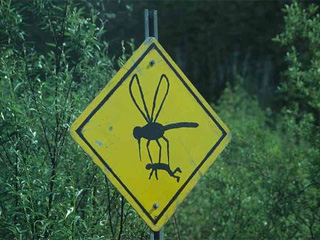
Once again, its time to add to the Official “Stupid Things Used To Fear Monger About Global Warming” List. The new entry is plants and animals are migrating to the north. Cluttering the northern slope of Alaska for example. But it's not just Alaska, Many animal species are now living north of where they used to. For example one type of mosquito has migrated to Florida (no its not a species of retired Jewish mosquitoes). So the migration of animals can no be added to the official list.
Since July 2009 global warming moonbats have blamed each of the following on global warming, climate change or whatever they decided to call it these days:
Incredible shrinking sheep, Invasion of jellyfish in the Mediterranean, Surge in fatal shark attack, Boy Scout tornado deaths, Global conflict, Beer tasting different, Suicide of farmers in Australia, Bigger tuna fish, longer days, shorter days, Collapse of gingerbread houses in Sweden, Cow infertility, UFO sightings in the UK, Rise in insurance premiums, Heroin addiction, Frigid Cold Winters in Great Britain, Cancer, Death from heart disease, diabetes, stroke, respiratory disease and even accidents, homicide, suicide, water -borne disease outbreaks, heavier, wetter snowstorms treacherous for travel and ambulation, Lyme disease, swarms of allergy-inducing, stinging insects, along with mosquitoes and devastating pine bark beetle infestations and the spread of forest and crop pests, 40,000 dead crabs , unrest in the Middle East. screwed-up love making, the Japanese earthquake-tsunami, horrible rash of tornadoes in southeast United States,The Arab Spring, extended severe allergy seasons, Lyme disease, malaria or dengue fever, trauma, depression, high blood pressure and heart disease,and increased threat of wars, violence, military action against the UK and Vampire Bats
According to a new study led by conservation biologist Chris D. Thomas of the University of York (England), not only are animals moving north, but the fact that they are moving because of global warming is now an established scientific fact. Along with their northern expansion animals are moving to higher elevations to cool off.
Thomas, told the Washington Post
Translating that from the scientific jargon, Thomas is saying“This more or less puts to bed the issue of whether these shifts are related to climate change. There isn’t any obvious alternative explanation for why species should be moving poleward in studies around the world.”
"since conservation is my specialty, and I can't think of any other explanation, I am going to blame the migration on global warming. There that settles it!
Thomas' new analysis used data from over 50 papers and included altitude data on 23 plant and animal groups and latitude data from 31 groups.
Despite expected variations in such shifts from species to species, the study revealed a clear trend: uphill migration, on average, was 36 feet per decade (11.0 meters) and migration away from the equator was 10 miles (16.9 km) per decade. These rates of migration are 2 to 3 times grater than findings from the last major migration study, conducted in 2003, indicting a likely acceleration trend.
According to the report As temperatures rise, these species’ survival often depends upon moving to cooler locales, such as higher-up mountain slopes. This of course, brings the migrating species into contact with the already established (in that niche) species. This can result in co-existence (a new, stable ecological web), or a reshuffling of the web. Amongst similar species (such as moths and birds), the result is often increased competition over food sources and/or the up-slope-migrating species driving out the previously established one.
What is not discernible, is if the study took into account the encroachment of human habitats on the animal Eco-systems or the natural increased heat from man's development of land, not global warming but for example, if you were to build a home in a desolate area and that home was heated, the area in the vicinity of that house would be warmer. Now make that home a village, small city or megalopolis and imagine the increased heat.In some cases, such as with certain species of butterfly in the Sierra Nevada mountains, the pushed-out species has nowhere to move to, and its existence becomes imperiled. Another example of accelerating migration is the North American pika (a mountain-dwelling rodent) which has shown a ten-fold increase in its up-slope migration (per decade) just in the past 20 years or so.
As an example, the return of dengue fever carrying mosquitoes to Key West Florida in 2009 — after an absence of more than 75 years — has been blamed on warming-induced insect migration.
An explanation just as viable as the one coming from the alarmists would be that baby-boomer mosquitoes all became 55 at approximately the same time and are slowly migrating to Miami were they can feast on old Jews who are feasting on early bird specials.
The migrating theory is typical of the climate change hoaxers. They selected old research that didn't give them the answer they wanted, asked only the questions that would prove their hypothesis and "presto-chango" the science is settled.
The problem is the rest of us have to pick up the pieces from their half-assed research.
But now comes evidence from the largest-scale analysis to date that such northward, migratory expansions and accelerating movements up-slope (i.e., to cooler/higher elevations) are largely attributable to warming and climate forcings.
The study, led by conservation biologist Chris D. Thomas of the University of York (England), “puts to bed” the question of whether these shifts in flora and fauna ranges and altitudes are due to climate change. According to Thomas, as quoted in a recent Washington Post article (see link below), “There isn’t any obvious alternative explanation for why species should be moving poleward in studies around the world.”
The new meta-analysis incorporated data from over 50 papers and included altitude data on 23 plant and animal groups and latitude data (i.e., range shifts northward) from 31 groups. One of the more general findings of the study, which analyzed species migrations in Europe, North America, Chile and Malaysia, was that greater warming in any given region was strongly correlated to farther, northward migration (to cooler climes).

Despite expected variations in such shifts from species to species, the study revealed a clear trend: uphill migration, on average, was 36 feet per decade (11.0 meters) and migration away from the equator was 10 miles (16.9 km) per decade. These rates of migration are 2 to 3 times grater than findings from the last major migration study, conducted in 2003, indicting a likely acceleration trend.
While some plant and animal species thrive in warming temperatures (which can open new zones to colonize), many plant and animal species are adapted to ecological niches that fall within a relatively narrow temperature range. As temperatures rise, these species’ survival often depends upon moving to cooler locales, such as higher-up mountain slopes. This of course, brings the migrating species into contact with the already established (in that niche) species. This can result in co-existence (a new, stable ecological web), or a reshuffling of the web. Amongst similar species (such as moths and birds), the result is often increased competition over food sources and/or the up-slope-migrating species driving out the previously established one.
In some cases, such as with certain species of butterfly in the Sierra Nevada mountains, the pushed-out species has nowhere to move to, and its existence becomes imperiled. Another example of accelerating migration is the North American pika (a mountain-dwelling rodent) which has shown a ten-fold increase in its up-slope migration (per decade) just in the past 20 years or so.
The researchers also note the variation in migratory ranges between individual species and suggest that multiple factors may be at work in these responses.
Quoting from the paper’s abstract:

Exceptions do exist; some bird species, like the Cirl bunting, actually have migrated to warmer regions, proving that at least a few animal species are more flexible in their adaptive responses to changing climate conditions.
One other puzzling outcome of this meta-analysis was a slower late of migration up-slope than was anticipated. Since one need migrate a shorter distance up-slope in order to encounter cooler temperatures (about 100 meters for a 0.5° C drop), it was theorized that higher elevation movements would occur faster. Their findings did not support this hypothesis. One explanation is that the given animal population is in fact moving laterally on the mountain face, possibly being squeezed by higher-up species and/or to achieve a more northerly-facing direction (which receives less sunlight).
Many biologist are concerned that some species will not be able to move (adapt) quickly enough, or simply run out of room to migrate to. The ultimate effects of this ecological reshuffling are unknown and still a mater of intense study.
And, there is an additional threat here to human health: the World Health Organization and Centers for Disease Control have issued warnings in the past that pathogen carrying insects (such as mosquitoes carrying malaria, dengue fever, etc.) will also expand their ranges in response to steady, global warming.

As an example, the return of dengue fever carrying mosquitoes to Key West Florida in 2009 — after an absence of more than 75 years — has been blamed on warming-induced insect migration.
The study, Rapid Range Shifts of Species Associated with High Levels of Climate Warming (Chen et al) was published in the August 19 edition of the journal Science.
Some source material for this post came from the Washington Post article: Plants and animals migrating upward as climate change by Brian Vastag, and, the Science Now article In Warming World, Critters Run to the Hills by Sara Reardon.
Top photo: (Parnassian Butterfly) Heather Dwyer / UC Davis
Second photo: (American pika) Justin.Johnsen; CC – By -SA 3.0
Third photo: (Cirl b
The study, led by conservation biologist Chris D. Thomas of the University of York (England), “puts to bed” the question of whether these shifts in flora and fauna ranges and altitudes are due to climate change. According to Thomas, as quoted in a recent Washington Post article (see link below), “There isn’t any obvious alternative explanation for why species should be moving poleward in studies around the world.”
The new meta-analysis incorporated data from over 50 papers and included altitude data on 23 plant and animal groups and latitude data (i.e., range shifts northward) from 31 groups. One of the more general findings of the study, which analyzed species migrations in Europe, North America, Chile and Malaysia, was that greater warming in any given region was strongly correlated to farther, northward migration (to cooler climes).

American Pika (Ochotona princeps) is migrating up-slope ten times faster than in did in the 1990's
While some plant and animal species thrive in warming temperatures (which can open new zones to colonize), many plant and animal species are adapted to ecological niches that fall within a relatively narrow temperature range. As temperatures rise, these species’ survival often depends upon moving to cooler locales, such as higher-up mountain slopes. This of course, brings the migrating species into contact with the already established (in that niche) species. This can result in co-existence (a new, stable ecological web), or a reshuffling of the web. Amongst similar species (such as moths and birds), the result is often increased competition over food sources and/or the up-slope-migrating species driving out the previously established one.
In some cases, such as with certain species of butterfly in the Sierra Nevada mountains, the pushed-out species has nowhere to move to, and its existence becomes imperiled. Another example of accelerating migration is the North American pika (a mountain-dwelling rodent) which has shown a ten-fold increase in its up-slope migration (per decade) just in the past 20 years or so.
The researchers also note the variation in migratory ranges between individual species and suggest that multiple factors may be at work in these responses.
Quoting from the paper’s abstract:
“The distances moved by species are greatest in studies showing the highest levels of warming [emphasis added] with average latitudinal shifts being generally sufficient to track temperature changes. However, individual species vary greatly in their rates of change, suggesting that the range shift of each species depends on multiple internal species traits and external drivers of change. Rapid average shifts derive from a wide diversity of responses by individual species. “
The researchers also sought to determine how far a given species of plant or animal in a given region had to migrate in order to find the same or cooler temperature. Surprisingly, the average distance turned out to be between 50 and 60 km to attain a 0.5° C cooler temp, which is considered quite fast considering that often these regions are populated by humans. More surprisingly, there was no difference in movement rate noted across taxonomic groups; plants and insects move equally fast, and birds and mammals move equally fast.
The Cirl Bunting (Emberiza cirlus) is moving into warmer regions, a more flexible response to climate change.
One other puzzling outcome of this meta-analysis was a slower late of migration up-slope than was anticipated. Since one need migrate a shorter distance up-slope in order to encounter cooler temperatures (about 100 meters for a 0.5° C drop), it was theorized that higher elevation movements would occur faster. Their findings did not support this hypothesis. One explanation is that the given animal population is in fact moving laterally on the mountain face, possibly being squeezed by higher-up species and/or to achieve a more northerly-facing direction (which receives less sunlight).
Many biologist are concerned that some species will not be able to move (adapt) quickly enough, or simply run out of room to migrate to. The ultimate effects of this ecological reshuffling are unknown and still a mater of intense study.
And, there is an additional threat here to human health: the World Health Organization and Centers for Disease Control have issued warnings in the past that pathogen carrying insects (such as mosquitoes carrying malaria, dengue fever, etc.) will also expand their ranges in response to steady, global warming.

The mosquito Aedes aegypti feeding off a human host. Warming temperatures could mean that mosquito born diseases like malaria and dengue fever may become more common in more northerly regions.
The study, Rapid Range Shifts of Species Associated with High Levels of Climate Warming (Chen et al) was published in the August 19 edition of the journal Science.
Some source material for this post came from the Washington Post article: Plants and animals migrating upward as climate change by Brian Vastag, and, the Science Now article In Warming World, Critters Run to the Hills by Sara Reardon.
Top photo: (Parnassian Butterfly) Heather Dwyer / UC Davis
Second photo: (American pika) Justin.Johnsen; CC – By -SA 3.0
Third photo: (Cirl b
Source: Planetsave (http://s.tt/135WO)
But now comes evidence from the largest-scale analysis to date that such northward, migratory expansions and accelerating movements up-slope (i.e., to cooler/higher elevations) are largely attributable to warming and climate forcings.
The study, led by conservation biologist Chris D. Thomas of the University of York (England), “puts to bed” the question of whether these shifts in flora and fauna ranges and altitudes are due to climate change. According to Thomas, as quoted in a recent Washington Post article (see link below), “There isn’t any obvious alternative explanation for why species should be moving poleward in studies around the world.”
The new meta-analysis incorporated data from over 50 papers and included altitude data on 23 plant and animal groups and latitude data (i.e., range shifts northward) from 31 groups. One of the more general findings of the study, which analyzed species migrations in Europe, North America, Chile and Malaysia, was that greater warming in any given region was strongly correlated to farther, northward migration (to cooler climes).
Despite expected variations in such shifts from species to species, the study revealed a clear trend: uphill migration, on average, was 36 feet per decade (11.0 meters) and migration away from the equator was 10 miles (16.9 km) per decade. These rates of migration are 2 to 3 times grater than findings from the last major migration study, conducted in 2003, indicting a likely acceleration trend.
While some plant and animal species thrive in warming temperatures (which can open new zones to colonize), many plant and animal species are adapted to ecological niches that fall within a relatively narrow temperature range. As temperatures rise, these species’ survival often depends upon moving to cooler locales, such as higher-up mountain slopes. This of course, brings the migrating species into contact with the already established (in that niche) species. This can result in co-existence (a new, stable ecological web), or a reshuffling of the web. Amongst similar species (such as moths and birds), the result is often increased competition over food sources and/or the up-slope-migrating species driving out the previously established one.
In some cases, such as with certain species of butterfly in the Sierra Nevada mountains, the pushed-out species has nowhere to move to, and its existence becomes imperiled. Another example of accelerating migration is the North American pika (a mountain-dwelling rodent) which has shown a ten-fold increase in its up-slope migration (per decade) just in the past 20 years or so.
The researchers also note the variation in migratory ranges between individual species and suggest that multiple factors may be at work in these responses.
Quoting from the paper’s abstract:
Exceptions do exist; some bird species, like the Cirl bunting, actually have migrated to warmer regions, proving that at least a few animal species are more flexible in their adaptive responses to changing climate conditions.
One other puzzling outcome of this meta-analysis was a slower late of migration up-slope than was anticipated. Since one need migrate a shorter distance up-slope in order to encounter cooler temperatures (about 100 meters for a 0.5° C drop), it was theorized that higher elevation movements would occur faster. Their findings did not support this hypothesis. One explanation is that the given animal population is in fact moving laterally on the mountain face, possibly being squeezed by higher-up species and/or to achieve a more northerly-facing direction (which receives less sunlight).
Many biologist are concerned that some species will not be able to move (adapt) quickly enough, or simply run out of room to migrate to. The ultimate effects of this ecological reshuffling are unknown and still a mater of intense study.
And, there is an additional threat here to human health: the World Health Organization and Centers for Disease Control have issued warnings in the past that pathogen carrying insects (such as mosquitoes carrying malaria, dengue fever, etc.) will also expand their ranges in response to steady, global warming.
As an example, the return of dengue fever carrying mosquitoes to Key West Florida in 2009 — after an absence of more than 75 years — has been blamed on warming-induced insect migration.
The study, Rapid Range Shifts of Species Associated with High Levels of Climate Warming (Chen et al) was published in the August 19 edition of the journal Science.
Some source material for this post came from the Washington Post article: Plants and animals migrating upward as climate change by Brian Vastag, and, the Science Now article In Warming World, Critters Run to the Hills by Sara Reardon.
Top photo: (Parnassian Butterfly) Heather Dwyer / UC Davis
Second photo: (American pika) Justin.Johnsen; CC – By -SA 3.0
Third photo: (Cirl b
The study, led by conservation biologist Chris D. Thomas of the University of York (England), “puts to bed” the question of whether these shifts in flora and fauna ranges and altitudes are due to climate change. According to Thomas, as quoted in a recent Washington Post article (see link below), “There isn’t any obvious alternative explanation for why species should be moving poleward in studies around the world.”
The new meta-analysis incorporated data from over 50 papers and included altitude data on 23 plant and animal groups and latitude data (i.e., range shifts northward) from 31 groups. One of the more general findings of the study, which analyzed species migrations in Europe, North America, Chile and Malaysia, was that greater warming in any given region was strongly correlated to farther, northward migration (to cooler climes).
American Pika (Ochotona princeps) is migrating up-slope ten times faster than in did in the 1990's
While some plant and animal species thrive in warming temperatures (which can open new zones to colonize), many plant and animal species are adapted to ecological niches that fall within a relatively narrow temperature range. As temperatures rise, these species’ survival often depends upon moving to cooler locales, such as higher-up mountain slopes. This of course, brings the migrating species into contact with the already established (in that niche) species. This can result in co-existence (a new, stable ecological web), or a reshuffling of the web. Amongst similar species (such as moths and birds), the result is often increased competition over food sources and/or the up-slope-migrating species driving out the previously established one.
In some cases, such as with certain species of butterfly in the Sierra Nevada mountains, the pushed-out species has nowhere to move to, and its existence becomes imperiled. Another example of accelerating migration is the North American pika (a mountain-dwelling rodent) which has shown a ten-fold increase in its up-slope migration (per decade) just in the past 20 years or so.
The researchers also note the variation in migratory ranges between individual species and suggest that multiple factors may be at work in these responses.
Quoting from the paper’s abstract:
“The distances moved by species are greatest in studies showing the highest levels of warming [emphasis added] with average latitudinal shifts being generally sufficient to track temperature changes. However, individual species vary greatly in their rates of change, suggesting that the range shift of each species depends on multiple internal species traits and external drivers of change. Rapid average shifts derive from a wide diversity of responses by individual species. “
The researchers also sought to determine how far a given species of plant or animal in a given region had to migrate in order to find the same or cooler temperature. Surprisingly, the average distance turned out to be between 50 and 60 km to attain a 0.5° C cooler temp, which is considered quite fast considering that often these regions are populated by humans. More surprisingly, there was no difference in movement rate noted across taxonomic groups; plants and insects move equally fast, and birds and mammals move equally fast.The Cirl Bunting (Emberiza cirlus) is moving into warmer regions, a more flexible response to climate change.
One other puzzling outcome of this meta-analysis was a slower late of migration up-slope than was anticipated. Since one need migrate a shorter distance up-slope in order to encounter cooler temperatures (about 100 meters for a 0.5° C drop), it was theorized that higher elevation movements would occur faster. Their findings did not support this hypothesis. One explanation is that the given animal population is in fact moving laterally on the mountain face, possibly being squeezed by higher-up species and/or to achieve a more northerly-facing direction (which receives less sunlight).
Many biologist are concerned that some species will not be able to move (adapt) quickly enough, or simply run out of room to migrate to. The ultimate effects of this ecological reshuffling are unknown and still a mater of intense study.
And, there is an additional threat here to human health: the World Health Organization and Centers for Disease Control have issued warnings in the past that pathogen carrying insects (such as mosquitoes carrying malaria, dengue fever, etc.) will also expand their ranges in response to steady, global warming.
The mosquito Aedes aegypti feeding off a human host. Warming temperatures could mean that mosquito born diseases like malaria and dengue fever may become more common in more northerly regions.
The study, Rapid Range Shifts of Species Associated with High Levels of Climate Warming (Chen et al) was published in the August 19 edition of the journal Science.
Some source material for this post came from the Washington Post article: Plants and animals migrating upward as climate change by Brian Vastag, and, the Science Now article In Warming World, Critters Run to the Hills by Sara Reardon.
Top photo: (Parnassian Butterfly) Heather Dwyer / UC Davis
Second photo: (American pika) Justin.Johnsen; CC – By -SA 3.0
Third photo: (Cirl b
Source: Planetsave (http://s.tt/135WO
All over the warming globe, plant and animal species are moving up…northward and to higher elevations, that is…in order to find cooler temperatures. Evidence from the largest-scale migration study ever conducted shows that this trend is accelerating.

The Clodius Parnassian butterfly is more common at the top of its elevation range in the California mountains than in the past. Such insects are known as 'harbinger' or 'indicator' species because thay are typically the first to respond to climate changes.
But now comes evidence from the largest-scale analysis to date that such northward, migratory expansions and accelerating movements up-slope (i.e., to cooler/higher elevations) are largely attributable to warming and climate forcings.
The study, led by conservation biologist Chris D. Thomas of the University of York (England), “puts to bed” the question of whether these shifts in flora and fauna ranges and altitudes are due to climate change. According to Thomas, as quoted in a recent Washington Post article (see link below), “There isn’t any obvious alternative explanation for why species should be moving poleward in studies around the world.”
The new meta-analysis incorporated data from over 50 papers and included altitude data on 23 plant and animal groups and latitude data (i.e., range shifts northward) from 31 groups. One of the more general findings of the study, which analyzed species migrations in Europe, North America, Chile and Malaysia, was that greater warming in any given region was strongly correlated to farther, northward migration (to cooler climes).
American Pika (Ochotona princeps) is migrating up-slope ten times faster than in did in the 1990's
While some plant and animal species thrive in warming temperatures (which can open new zones to colonize), many plant and animal species are adapted to ecological niches that fall within a relatively narrow temperature range. As temperatures rise, these species’ survival often depends upon moving to cooler locales, such as higher-up mountain slopes. This of course, brings the migrating species into contact with the already established (in that niche) species. This can result in co-existence (a new, stable ecological web), or a reshuffling of the web. Amongst similar species (such as moths and birds), the result is often increased competition over food sources and/or the up-slope-migrating species driving out the previously established one.
In some cases, such as with certain species of butterfly in the Sierra Nevada mountains, the pushed-out species has nowhere to move to, and its existence becomes imperiled. Another example of accelerating migration is the North American pika (a mountain-dwelling rodent) which has shown a ten-fold increase in its up-slope migration (per decade) just in the past 20 years or so.
The researchers also note the variation in migratory ranges between individual species and suggest that multiple factors may be at work in these responses.
Quoting from the paper’s abstract:
“The distances moved by species are greatest in studies showing the highest levels of warming [emphasis added] with average latitudinal shifts being generally sufficient to track temperature changes. However, individual species vary greatly in their rates of change, suggesting that the range shift of each species depends on multiple internal species traits and external drivers of change. Rapid average shifts derive from a wide diversity of responses by individual species. “
The researchers also sought to determine how far a given species of plant or animal in a given region had to migrate in order to find the same or cooler temperature. Surprisingly, the average distance turned out to be between 50 and 60 km to attain a 0.5° C cooler temp, which is considered quite fast considering that often these regions are populated by humans. More surprisingly, there was no difference in movement rate noted across taxonomic groups; plants and insects move equally fast, and birds and mammals move equally fast.The Cirl Bunting (Emberiza cirlus) is moving into warmer regions, a more flexible response to climate change.
One other puzzling outcome of this meta-analysis was a slower late of migration up-slope than was anticipated. Since one need migrate a shorter distance up-slope in order to encounter cooler temperatures (about 100 meters for a 0.5° C drop), it was theorized that higher elevation movements would occur faster. Their findings did not support this hypothesis. One explanation is that the given animal population is in fact moving laterally on the mountain face, possibly being squeezed by higher-up species and/or to achieve a more northerly-facing direction (which receives less sunlight).
Many biologist are concerned that some species will not be able to move (adapt) quickly enough, or simply run out of room to migrate to. The ultimate effects of this ecological reshuffling are unknown and still a mater of intense study.
And, there is an additional threat here to human health: the World Health Organization and Centers for Disease Control have issued warnings in the past that pathogen carrying insects (such as mosquitoes carrying malaria, dengue fever, etc.) will also expand their ranges in response to steady, global warming.
The mosquito Aedes aegypti feeding off a human host. Warming temperatures could mean that mosquito born diseases like malaria and dengue fever may become more common in more northerly regions.
The study, Rapid Range Shifts of Species Associated with High Levels of Climate Warming (Chen et al) was published in the August 19 edition of the journal Science.
Some source material for this post came from the Washington Post article: Plants and animals migrating upward as climate change by Brian Vastag, and, the Science Now article In Warming World, Critters Run to the Hills by Sara Reardon.
Top photo: (Parnassian Butterfly) Heather Dwyer / UC Davis
Second photo: (American pika) Justin.Johnsen; CC – By -SA 3.0
Third photo: (Cirl bunting) Paco Gómez from Castellón, Spain; CC – By – SA 3.0
Source: Planetsave (http://s.tt/135WO)
All over the warming globe, plant and animal species are moving up…northward and to higher elevations, that is…in order to find cooler temperatures. Evidence from the largest-scale migration study ever conducted shows that this trend is accelerating.
The Clodius Parnassian butterfly is more common at the top of its elevation range in the California mountains than in the past. Such insects are known as 'harbinger' or 'indicator' species because thay are typically the first to respond to climate changes.
But now comes evidence from the largest-scale analysis to date that such northward, migratory expansions and accelerating movements up-slope (i.e., to cooler/higher elevations) are largely attributable to warming and climate forcings.
The study, led by conservation biologist Chris D. Thomas of the University of York (England), “puts to bed” the question of whether these shifts in flora and fauna ranges and altitudes are due to climate change. According to Thomas, as quoted in a recent Washington Post article (see link below), “There isn’t any obvious alternative explanation for why species should be moving poleward in studies around the world.”
The new meta-analysis incorporated data from over 50 papers and included altitude data on 23 plant and animal groups and latitude data (i.e., range shifts northward) from 31 groups. One of the more general findings of the study, which analyzed species migrations in Europe, North America, Chile and Malaysia, was that greater warming in any given region was strongly correlated to farther, northward migration (to cooler climes).
American Pika (Ochotona princeps) is migrating up-slope ten times faster than in did in the 1990's
While some plant and animal species thrive in warming temperatures (which can open new zones to colonize), many plant and animal species are adapted to ecological niches that fall within a relatively narrow temperature range. As temperatures rise, these species’ survival often depends upon moving to cooler locales, such as higher-up mountain slopes. This of course, brings the migrating species into contact with the already established (in that niche) species. This can result in co-existence (a new, stable ecological web), or a reshuffling of the web. Amongst similar species (such as moths and birds), the result is often increased competition over food sources and/or the up-slope-migrating species driving out the previously established one.
In some cases, such as with certain species of butterfly in the Sierra Nevada mountains, the pushed-out species has nowhere to move to, and its existence becomes imperiled. Another example of accelerating migration is the North American pika (a mountain-dwelling rodent) which has shown a ten-fold increase in its up-slope migration (per decade) just in the past 20 years or so.
The researchers also note the variation in migratory ranges between individual species and suggest that multiple factors may be at work in these responses.
Quoting from the paper’s abstract:
“The distances moved by species are greatest in studies showing the highest levels of warming [emphasis added] with average latitudinal shifts being generally sufficient to track temperature changes. However, individual species vary greatly in their rates of change, suggesting that the range shift of each species depends on multiple internal species traits and external drivers of change. Rapid average shifts derive from a wide diversity of responses by individual species. “
The researchers also sought to determine how far a given species of plant or animal in a given region had to migrate in order to find the same or cooler temperature. Surprisingly, the average distance turned out to be between 50 and 60 km to attain a 0.5° C cooler temp, which is considered quite fast considering that often these regions are populated by humans. More surprisingly, there was no difference in movement rate noted across taxonomic groups; plants and insects move equally fast, and birds and mammals move equally fast.The Cirl Bunting (Emberiza cirlus) is moving into warmer regions, a more flexible response to climate change.
One other puzzling outcome of this meta-analysis was a slower late of migration up-slope than was anticipated. Since one need migrate a shorter distance up-slope in order to encounter cooler temperatures (about 100 meters for a 0.5° C drop), it was theorized that higher elevation movements would occur faster. Their findings did not support this hypothesis. One explanation is that the given animal population is in fact moving laterally on the mountain face, possibly being squeezed by higher-up species and/or to achieve a more northerly-facing direction (which receives less sunlight).
Many biologist are concerned that some species will not be able to move (adapt) quickly enough, or simply run out of room to migrate to. The ultimate effects of this ecological reshuffling are unknown and still a mater of intense study.
And, there is an additional threat here to human health: the World Health Organization and Centers for Disease Control have issued warnings in the past that pathogen carrying insects (such as mosquitoes carrying malaria, dengue fever, etc.) will also expand their ranges in response to steady, global warming.
The mosquito Aedes aegypti feeding off a human host. Warming temperatures could mean that mosquito born diseases like malaria and dengue fever may become more common in more northerly regions.
The study, Rapid Range Shifts of Species Associated with High Levels of Climate Warming (Chen et al) was published in the August 19 edition of the journal Science.
Some source material for this post came from the Washington Post article: Plants and animals migrating upward as climate change by Brian Vastag, and, the Science Now article In Warming World, Critters Run to the Hills by Sara Reardon.
Top photo: (Parnassian Butterfly) Heather Dwyer / UC Davis
Second photo: (American pika) Justin.Johnsen; CC – By -SA 3.0
Third photo: (Cirl bunting) Paco Gómez from Castellón, Spain; CC – By – SA 3.0
Source: Planetsave (http://s.tt/135WO)


